


Pay-per-click advertising lets a business appear in front of people at the exact moment they search for what it sells, and pay only when someone clicks. Done well, it can produce leads within days. Done badly, it is one of the fastest ways to spend money with nothing to show for it.
This guide explains how PPC works, with a focus on Google Ads because it is where most businesses start. We cover auctions, Quality Score, campaign types, keywords, landing pages, tracking and budgets, plus the mistakes we see most often when we audit accounts.
What is PPC?
Pay-per-click (PPC) is an online advertising model in which the advertiser pays each time someone clicks an ad. The most common form is paid search: ads that appear above or below organic results when people search for particular terms. PPC also includes shopping ads, display banners, video ads and paid social campaigns, although some of those are often charged per thousand impressions rather than per click.
How does PPC advertising work?
- You choose what to target: keywords (for search), products (for shopping) or audiences (for display, video and social).
- You write ads and choose where each click should land on your website.
- You set a budget and a bidding approach.
- When someone searches or browses, an automated auction runs in a fraction of a second to decide which ads appear and in what order.
- You pay when someone clicks (or, for some campaigns, per impression or conversion).
- Conversion tracking shows which clicks became calls, leads or sales, so you can adjust.
What is Google Ads?
Google Ads is Google’s advertising platform. It can show ads on Google Search, Google Maps, Google Shopping, YouTube, Gmail and millions of partner websites and apps in the Google Display Network. Microsoft Advertising offers similar search ads on Bing and partner sites, often at a lower cost per click.
Types of PPC advertising
| Campaign type | Where ads appear | Best for |
|---|---|---|
| Search | Google Search results | Capturing people actively looking for a product or service |
| Display | Websites and apps in the Google Display Network | Awareness and remarketing |
| Shopping | Shopping results with product images and prices | Ecommerce stores |
| Performance Max | Across Google’s channels from one campaign | Advertisers with good conversion data and assets |
| Video | YouTube and video partners | Explaining products, awareness, consideration |
| Demand Gen | YouTube, Discover and Gmail feeds | Visual, interest-based campaigns |
| Paid social | Facebook, Instagram, LinkedIn, X | Audience-based targeting (see social media marketing) |
Search advertising
Search ads are text ads triggered by keywords. They are usually the best starting point because they reach people with clear intent. A person searching “emergency electrician near me” is ready to call someone now.
Display advertising
Display ads are image or responsive ads shown on websites, apps and YouTube. They reach people while they browse rather than search, so they work best for awareness and for reminding previous visitors about you.
Shopping campaigns
Shopping ads show a product image, title, price and store name. They are powered by a product feed in Google Merchant Center rather than keywords, so feed quality (accurate titles, descriptions, images, prices and availability) has a big effect on results.
Performance Max
Performance Max is a goal-based campaign type that uses Google’s automation to find conversions across Search, YouTube, Display, Discover, Gmail and Maps from a single campaign. You provide goals, budgets, creative assets and audience signals; Google’s systems decide where to show ads. It can work well with strong conversion tracking, but it offers less control and transparency, so it should be monitored carefully. See our article on Performance Max campaigns.
Video advertising
Video ads on YouTube range from short skippable ads to longer formats. Advertisers typically pay when people watch or interact. They are useful for products that need explaining and for building familiarity before people search.
Remarketing
Remarketing (also called retargeting) shows ads to people who have already visited your website or engaged with you. It is effective because they already know you. Use it respectfully: limit how often people see ads and exclude recent customers. It requires clear consent and privacy notices. See remarketing done right.
Keyword research
Keywords tell Google which searches should trigger your ads. Good PPC keyword research focuses on commercial and transactional intent, the searches most likely to lead to a sale.
Match types control how closely a search must match your keyword:
- Broad match: ads can show for related searches, including ones without your exact words. Widest reach, needs strong negative keywords and good conversion data.
- Phrase match: ads show for searches that include the meaning of your keyword.
- Exact match: ads show for searches with the same meaning or intent as the keyword. Most control, least volume.
Negative keywords stop ads showing for irrelevant searches, for example “free,” “jobs” or “DIY” for a professional service. Reviewing the search terms report regularly and adding negatives is one of the most valuable routine tasks. Read our negative keywords guide.
Search intent and targeting
Beyond keywords, campaigns can be targeted by location (country, city, radius), language, device, time of day and audiences (such as previous visitors or customer lists). A local business should usually target only the area it serves and check location settings carefully, so ads do not show to people who are merely interested in the area.
Ad groups and campaign structure
A Google Ads account is organized in three levels:
- Account: billing and overall settings.
- Campaigns: budget, location, network and bidding strategy. Typically one campaign per major service, product line or goal.
- Ad groups: closely related keywords with ads and a landing page that match them.
Example: a dental clinic might have campaigns for “Implants,” “Emergency dentist” and “Teeth whitening,” each with its own budget, and ad groups inside “Implants” for “dental implants cost” and “single tooth implant.” Tight structure makes ads more relevant and reports easier to read. See our guide to Google Ads account structure.
Ad copywriting
Most search ads today are responsive search ads: you provide up to 15 headlines and 4 descriptions, and Google tests combinations. Good ad copy:
- Reflects the search (if someone searches “same-day boiler repair,” say same-day).
- States a clear benefit and what makes you different.
- Includes proof: reviews, years in business, guarantees you actually offer.
- Has a clear call to action.
- Uses assets (formerly extensions) such as sitelinks, callouts, call buttons and location.
Landing pages
The landing page is where the click goes, and it often matters more than the ad. A strong landing page matches the ad’s promise, loads quickly on mobile, explains the offer clearly, shows trust signals and makes the next step obvious (call, form, booking, buy). Sending paid traffic to a general homepage usually lowers conversion rates. Compare the options in PPC landing page vs. homepage.
Quality Score
Quality Score is a diagnostic rating from 1 to 10, shown at keyword level in Google Ads search campaigns. It is based on three components, each rated above average, average or below average:
- Expected click-through rate: how likely your ad is to be clicked.
- Ad relevance: how closely your ad matches the intent of the search.
- Landing page experience: how relevant and useful your landing page is.
Google is clear that Quality Score itself is not an input in the ad auction. It is a guide to where ads, keywords and landing pages can improve. The underlying quality of your ads and landing pages does affect your auction results through Ad Rank.
Ad Rank and auction basics
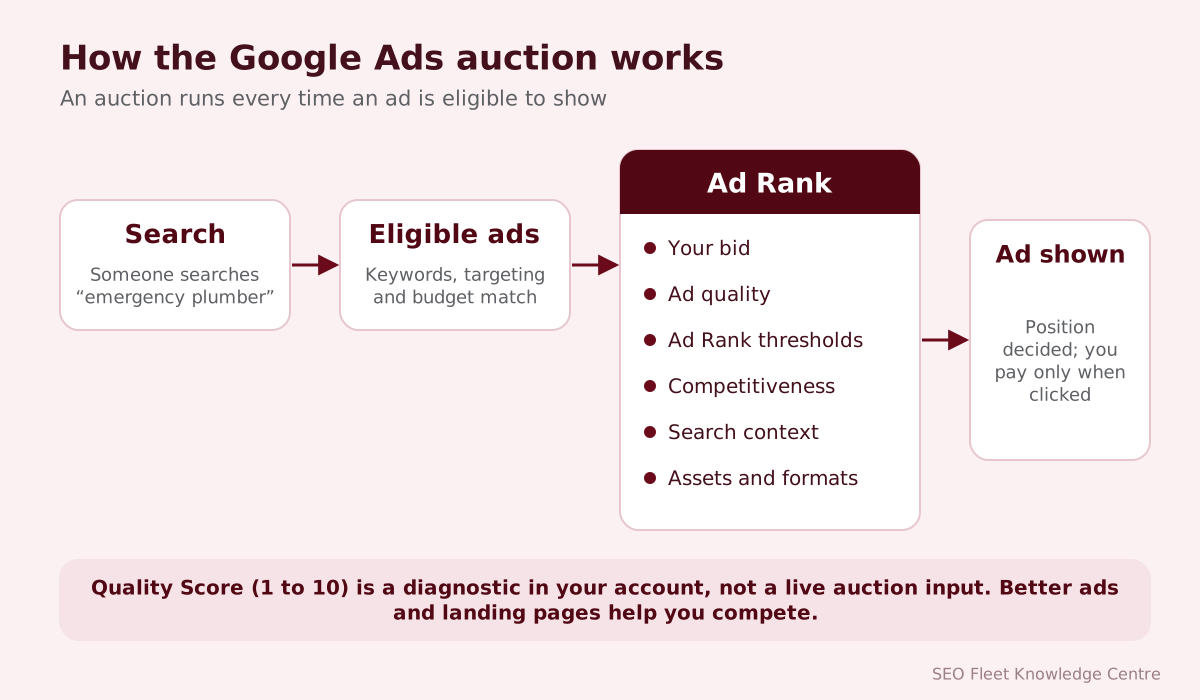
Each time an ad is eligible, Google calculates Ad Rank to decide whether it can show and where. According to Google, Ad Rank considers:
- Your bid.
- The quality of your ads and landing page.
- Ad Rank thresholds (minimum levels an ad must reach to show).
- The competitiveness of the auction.
- The context of the search (terms, location, device, time).
- The expected impact of assets and other ad formats.
This is why a relevant, well-written ad with a good landing page can sometimes appear above a competitor who bids more. You also rarely pay your full maximum bid: Google charges what is needed to hold your position, within your limit.
CPC, CPM and CPA
| Term | Meaning | Formula |
|---|---|---|
| CPC | Cost per click | Cost ÷ clicks |
| CPM | Cost per 1,000 impressions | Cost ÷ impressions × 1,000 |
| CPA | Cost per acquisition (lead, sale or other conversion) | Cost ÷ conversions |
| ROAS | Return on ad spend | Conversion value ÷ cost |
Conversion tracking
Without conversion tracking, you know what you spent but not what you got. Track every valuable action: form submissions, calls from ads and from the website, bookings, purchases, and if possible, which leads became customers. Google Ads can import conversions from Google Analytics 4 or use its own tag, often through Google Tag Manager. Enhanced conversions and offline conversion imports improve accuracy as browser privacy restrictions increase. Automated bidding is only as good as the conversion data it learns from. See conversion tracking your ads team can trust.
PPC budgeting
- Start from economics: what is a customer worth, and what can you afford to pay to win one? That sets your target CPA.
- Budget for learning: new campaigns need enough clicks and conversions to show what works. Too small a budget spread across many keywords teaches you nothing.
- Prioritize high-intent searches first, then expand.
- Separate media spend from management fees when comparing proposals.
Our guide how much to spend on Google Ads walks through a worked example.
Campaign optimization
- Review search terms and add negative keywords.
- Pause keywords and ads that spend without converting, after enough data.
- Test new headlines, offers and landing page changes one at a time.
- Adjust bids or targets by location, device and schedule based on results.
- Choose bidding strategies that match your goal and data volume (for example, Maximize conversions or Target CPA once tracking is reliable).
- Check that budget is not limiting your best campaigns.
Common PPC mistakes
- No conversion tracking, or tracking that counts the wrong things.
- Broad match keywords with no negative keywords.
- Sending all traffic to the homepage.
- Location settings that show ads far outside the service area.
- Accepting every automated recommendation without review.
- Too many campaigns with too little budget each.
- Judging results after a few days, or never reviewing them at all.
- Not knowing what a customer is worth, so no way to judge cost per lead.
PPC vs. SEO
| PPC | SEO | |
|---|---|---|
| Speed | Immediate | Builds over months |
| Cost | Pay per click | Investment in content and technical work |
| Control | High: keywords, ads, budget, timing | Lower: search engines decide rankings |
| Longevity | Stops when spending stops | Continues to work |
| Testing | Fast feedback on keywords and messages | Slower feedback |
Most businesses benefit from both: PPC for immediate leads and testing, SEO for long-term visibility.
How to measure PPC success
Focus on business results: conversions, cost per acquisition, conversion rate, return on ad spend and, where possible, revenue and profit from customers acquired. Click-through rate and Quality Score are useful diagnostics but not goals. Compare performance over meaningful periods, and account for seasonality and the time between a click and a sale.
When should a business hire a PPC agency?
- Your account is spending but you cannot tell which leads it produces.
- Costs per lead are rising and you do not know why.
- You lack time to review search terms and test ads every week.
- You are moving to automated bidding or Performance Max and need reliable tracking.
- You are expanding to new services, regions or platforms.
When choosing an agency, ask how they report, who owns the ad account (it should be you), how fees are structured and how often they optimize. An independent PPC audit is a good way to judge an existing account.
A simple worked PPC example
Consider an illustrative scenario. A plumbing company spends $3,000 in a month on search ads. Ads receive 1,500 clicks at an average cost per click of $2. The landing page converts 8% of clicks into calls or form submissions, giving 120 leads at a cost per lead of $25. If 30% of leads become jobs, that is 36 jobs at a cost of about $83 each. If the average job is worth $400 in gross profit, the campaign is clearly profitable. If the conversion rate fell to 3%, the same spend would produce 45 leads, about 14 jobs and a cost per job above $200. The example shows why landing pages and conversion tracking often matter as much as bids.
Conclusion
PPC gives businesses fast, controllable visibility in front of people who are ready to act. Its results depend on a few fundamentals: the right keywords and targeting, relevant ads, strong landing pages, reliable conversion tracking and regular optimization. Get those right and every dollar becomes easier to justify.
SEO Fleet has managed paid search since the early days of Google AdWords. Explore our Google Ads management, PPC management and conversion tracking services.


