


Twenty years ago, a local business that wanted more customers had a short list of options: a newspaper ad, a listing in the printed phone directory, a radio spot or a flyer through the door. You paid up front, hoped the right people noticed, and had very little idea what actually worked.
Today the same business has a website, a Google Business Profile, social media accounts, an email list and the ability to show an advertisement only to people searching for exactly what it sells, in a specific town, at a specific time of day. Customers research, compare, ask questions and buy online before they ever call. That shift is why every business now needs some form of digital marketing, and why doing it without a plan wastes so much money.
This guide explains what digital marketing is, how the main channels work, how to measure results and how to put the pieces together into a strategy. It is written for business owners and new marketers, but it reflects what SEO Fleet has learned delivering digital marketing since 2007.
What is digital marketing?
Digital marketing is the promotion of a business, its products or its services through digital channels: search engines, websites, social media, email, online advertising, video platforms, apps and messaging. It covers everything from appearing in Google’s results to sending a welcome email to a new subscriber.
A useful way to think about it: digital marketing is how a business gets found, earns trust and turns interest into action online. Advertising is only one part. Much of the work is about being useful in the places customers already look, then making it easy for them to take the next step.
Two features set digital marketing apart from older forms of promotion:
- It is measurable. You can see how many people saw a message, clicked, called, filled in a form or bought, and what each result cost.
- It is two-way. Customers can respond, comment, review, ask questions and share. That conversation is part of the marketing.
How does digital marketing work?
Most purchases follow a journey rather than a single moment. Digital marketing works by meeting people at each stage of that journey with the right message on the right channel.
| Stage | What the customer is doing | Typical channels |
|---|---|---|
| Awareness | Realizes they have a need or problem | Social media, video, display ads, digital PR |
| Discovery | Searches for options and information | Search engines, local results, content |
| Consideration | Compares providers, prices and reviews | Website, reviews, case studies, comparison content |
| Engagement | Interacts: reads, watches, subscribes, asks | Email, social media, chat, webinars |
| Conversion | Calls, books, buys or requests a quote | Landing pages, search ads, remarketing |
| Retention | Uses the product and comes back | Email, account content, support |
| Advocacy | Recommends and reviews | Review requests, referral programs, social sharing |
A practical example
Imagine a family-run dental clinic. A parent notices their child needs a checkup (awareness) and searches “children’s dentist near me” (discovery). The clinic’s Google Business Profile appears in the map results with good reviews, so the parent visits its website and reads a page about children’s appointments (consideration). They sign up for the clinic’s reminder emails (engagement), book online (conversion), receive a friendly reminder six months later (retention) and leave a review after a good visit (advocacy). Local SEO, the website, email and review management all worked together. None of them alone would have produced the same result.
Traditional marketing vs. digital marketing
Traditional marketing still has a place. A billboard on a busy road or a sponsorship at a local event can build awareness. But the two approaches behave very differently.
| Factor | Traditional marketing | Digital marketing |
|---|---|---|
| Reach | Limited to the area or audience of the outlet | Local, national or international, set by you |
| Targeting | Broad: everyone who reads, drives past or listens | Narrow: by search, location, interests, behavior or customer list |
| Cost | Usually paid up front, often with high minimums | Flexible budgets, often paid per click or result |
| Measurement | Estimated reach, hard to link to sales | Clicks, calls, leads and revenue tracked |
| Customer interaction | One-way | Two-way: comments, messages, reviews |
| Flexibility | Hard to change once printed or booked | Ads and pages can change the same day |
| Reporting | Infrequent and approximate | Continuous, in tools like Google Analytics |
The strongest plans often combine both: for example, a radio campaign that drives people to search for the brand name, supported by search ads and a strong website that captures that interest.
Types of digital marketing
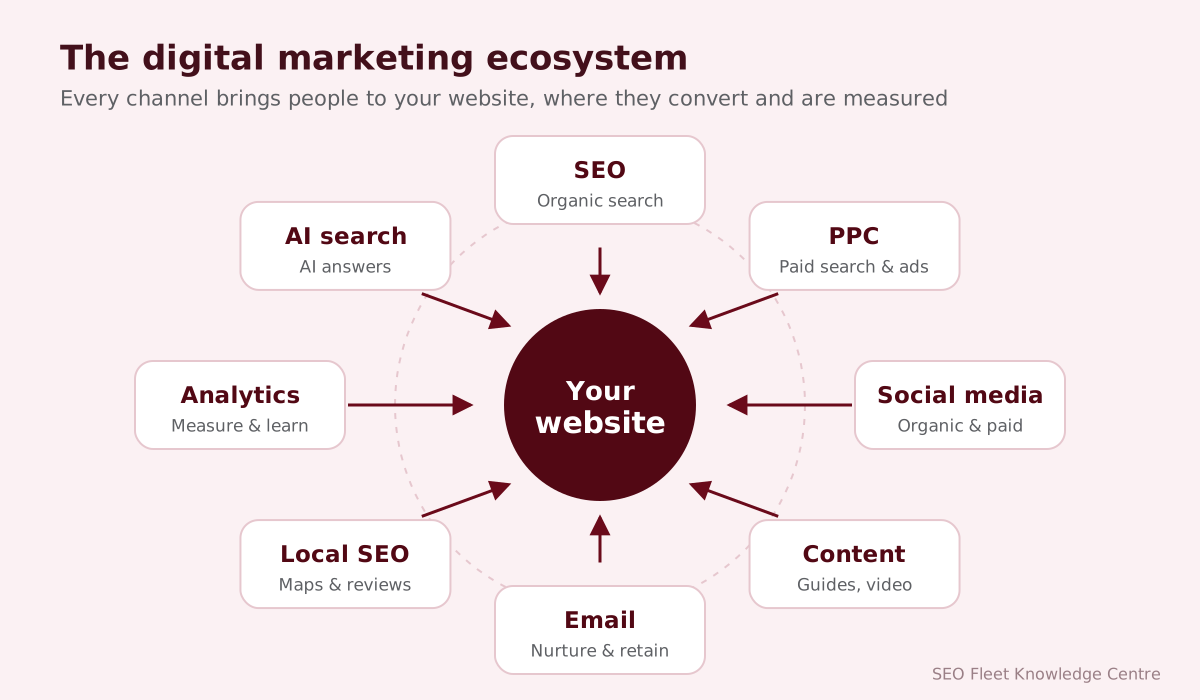
Digital marketing is a collection of disciplines. Each has its own skills, tools and timescales. Here is what each one means, how it works and when a business should consider it.
Search engine optimization (SEO)
What it is: improving a website so it appears in the unpaid (organic) results of search engines such as Google and Bing. How it works: technical improvements help search engines crawl and understand the site, useful content answers what people search for, and links and mentions from other sites build authority. Benefits: a steady flow of visitors who are already looking for what you offer, without paying for every click. Example: an accountancy firm publishes clear guides on tax deadlines and ranks for those searches each year. When to consider it: almost always, but especially when customers research before buying. Results build over months, so start early. Our complete guide to SEO covers it in depth.
Pay-per-click advertising (PPC)
What it is: advertising where you pay when someone clicks your ad, most commonly on Google Ads. How it works: you choose keywords, audiences and a budget; an automated auction decides which ads show and in what order. Benefits: immediate visibility, precise control and fast feedback. Example: an emergency plumber shows ads only to people searching “burst pipe repair” within a 20-mile radius. When to consider it: when you need leads quickly, are launching something new or want to test which messages work. See what PPC advertising is and how it works.
Social media marketing
What it is: using platforms such as Facebook, Instagram, LinkedIn, YouTube and TikTok to build an audience, engage customers and advertise. How it works: regular posts and conversations build familiarity; paid social ads reach specific audiences. Benefits: brand awareness, community and highly targeted advertising. Example: a bakery shares short videos of the morning bake and runs a local ad for its holiday orders. When to consider it: when your customers spend time on a platform and your product is easy to show. More in our social media marketing guide.
Content marketing
What it is: creating useful articles, guides, videos and tools that attract and help your audience. How it works: content answers real questions, earns search visibility and social shares, and builds trust before a sale. Benefits: long-lasting traffic, authority and material for every other channel. Example: a software company publishes a free checklist that becomes its most-visited page. When to consider it: when customers need information or reassurance before buying. See what content marketing is.
Email marketing
What it is: sending planned messages to people who have agreed to hear from you. How it works: newsletters, offers and automated sequences go to segmented lists. Benefits: you own the list, costs are low and it is excellent for repeat business. Example: an online store sends a reminder when a shopper leaves items in the cart. When to consider it: as soon as you have customers or subscribers. Read our email marketing guide.
Affiliate marketing
What it is: paying partners a commission when they refer a sale or lead. How it works: affiliates promote your products through their websites, reviews or newsletters using tracked links. Benefits: you mostly pay for results. Example: a travel insurance company pays travel bloggers per policy sold. When to consider it: for ecommerce and subscription businesses with healthy margins and good tracking.
Influencer marketing
What it is: working with creators who have the trust of a specific audience. How it works: the creator features your product in their own style, usually for a fee or free product, and must disclose the partnership. Benefits: credibility with audiences that ignore normal ads. Example: a fitness brand works with three local personal trainers rather than one celebrity. When to consider it: when the right creators genuinely match your customers.
Online reputation management
What it is: monitoring and improving what people find and say about your business online. How it works: asking happy customers for reviews, replying professionally to all reviews and correcting inaccurate information. Benefits: more trust at the moment of decision. Google lists the number and rating of reviews among the signals of a business’s prominence in local results. When to consider it: always, and urgently if reviews are few or negative.
Digital public relations
What it is: earning coverage and mentions on news sites, industry publications and blogs. How it works: newsworthy stories, original data and expert comment are pitched to journalists. Benefits: credibility, referral traffic and links that support SEO. When to consider it: when you have genuine expertise or data to share.
Mobile marketing
What it is: reaching people on smartphones through mobile-friendly websites, apps, SMS and location-aware ads. Benefits: most local searches and social browsing happen on phones. When to consider it: always make the website work well on mobile; SMS and apps depend on your business model and need explicit consent.
Video marketing
What it is: using video on YouTube, social platforms and your website to explain, demonstrate and entertain. Benefits: video shows products and people in a way text cannot. Example: a contractor posts short before-and-after videos of each project. When to consider it: when your product, service or team is better shown than described.
Local digital marketing
What it is: marketing aimed at customers in a specific area, centered on your Google Business Profile, local SEO, reviews and location-targeted ads. When to consider it: for any business that serves customers in person or within a service area. See our local SEO guide.
Marketing automation
What it is: software that sends the right message at the right time based on what people do. How it works: rules such as “when someone downloads this guide, send these three emails over two weeks.” Benefits: consistent follow-up without manual work. When to consider it: once you have a steady flow of leads or customers to nurture.
Important digital marketing channels
- Google Search: where most buying research starts. Organic results, local results and ads all appear here.
- Google Ads: Google’s advertising platform for search, shopping, display and YouTube campaigns.
- Facebook: a broad audience and one of the most detailed advertising platforms, through Meta’s ad tools.
- Instagram: visual content and short video, also advertised through Meta.
- LinkedIn: professional audiences, valuable for B2B services and recruitment.
- YouTube: long and short video, searchable, with its own advertising options.
- Email: a direct line to customers that you control.
- Business websites: the hub every other channel points to. If it is slow, confusing or hard to use on a phone, every channel performs worse.
- Online marketplaces: Amazon, eBay and similar platforms, where product businesses can reach buyers who are ready to purchase.
Benefits of digital marketing
- Increased visibility: you can appear where customers are already searching and scrolling.
- Targeted advertising: reach people by location, interest, search behavior or existing relationship.
- Measurable campaigns: see what each channel produces and what each result costs.
- Lead generation: forms, calls and bookings can be captured and followed up automatically.
- Customer engagement: conversations on social media and email build relationships.
- Brand awareness: consistent content keeps your business in mind until people are ready to buy.
- Market expansion: sell to new regions or countries without opening an office.
- Customer retention: email and remarketing bring customers back.
- Improved efficiency: budget moves to what works, quickly.
How to create a digital marketing strategy
A strategy is simply a written answer to: who are we trying to reach, where, with what message, for what result, and how will we know it worked? This nine-step framework is the one we use with clients.
- Define business objectives. Start with business goals, not marketing activity: “20 new maintenance contracts this quarter,” not “more followers.”
- Understand the target audience. Who buys, what problem they have, what they search for and what makes them hesitate. Talk to existing customers.
- Research competitors. Search for your main services and note who appears, what they offer and what their reviews say.
- Select appropriate channels. Choose the two or three channels where your customers are, rather than trying to be everywhere.
- Establish budgets. Separate fixed costs (website, tools, management) from media spend (ads), and decide how long you will test before judging results.
- Develop content. Plan the pages, posts, emails and ads each channel needs.
- Launch campaigns. Set up tracking first, then launch.
- Measure results. Review leads, sales and costs, not just clicks.
- Optimize performance. Keep what works, fix or stop what doesn’t, and test one improvement at a time.
SEO Fleet perspective: the most common reason campaigns disappoint is not the channel, it is missing tracking. Before spending on ads or content, make sure every form, call and purchase is recorded. Otherwise you cannot tell which half of your budget is working.
A realistic first 90 days for a small business
| Weeks | Focus | Typical tasks |
|---|---|---|
| 1 to 2 | Foundations | Fix website basics, set up Google Analytics 4, Search Console and conversion tracking, complete your Google Business Profile |
| 3 to 6 | First campaigns | Improve key service pages, start a small search ad campaign, ask recent customers for reviews |
| 7 to 10 | Content and follow-up | Publish helpful articles from real customer questions, set up a welcome email |
| 11 to 13 | Review | Compare cost per lead by channel, cut what is not working, plan the next quarter |
Important digital marketing metrics
Metrics only matter if they connect to business results. These are the ones worth understanding:
| Metric | What it means | How it is calculated |
|---|---|---|
| Impressions | How many times content or an ad was shown | Counted by the platform |
| Reach | How many different people saw it | Counted by the platform |
| Clicks | How many times people clicked through | Counted by the platform |
| CTR (click-through rate) | The share of impressions that became clicks | Clicks ÷ impressions × 100 |
| CPC (cost per click) | Average cost of one click | Cost ÷ clicks |
| CPM (cost per mille) | Cost of 1,000 impressions | Cost ÷ impressions × 1,000 |
| Conversion rate | The share of visits or clicks that took the desired action | Conversions ÷ clicks (or sessions) × 100 |
| Cost per lead (CPL) | What each inquiry cost | Cost ÷ leads |
| Customer acquisition cost (CAC) | What it costs to win one customer | Total marketing and sales cost ÷ new customers |
| ROAS (return on ad spend) | Revenue generated per unit of ad spend | Revenue from ads ÷ ad spend |
| ROI (return on investment) | Profit relative to total cost | (Profit − cost) ÷ cost × 100 |
| Customer lifetime value (CLV) | Revenue or profit from a customer over the whole relationship | Average order value × purchases per year × years retained |
Worked example: you spend $1,000 on search ads and receive 400 clicks (CPC $2.50). Twenty of those clicks fill in a form (conversion rate 5%, cost per lead $50). Five become customers, so the acquisition cost is $200 each. If an average customer is worth $1,200 over two years, that channel is profitable even though $200 per customer sounds high at first glance.
How much does digital marketing cost?
There is no honest single number, because costs depend on your market, competition, goals and how much you do in-house. What we can explain is how pricing works so you can compare quotes fairly:
- Monthly retainers: a fixed monthly fee for ongoing work such as SEO, social media or campaign management.
- Project-based pricing: a fixed price for a defined piece of work, such as a website, an audit or a campaign setup.
- Hourly services: paying for time used, useful for ongoing support and smaller tasks.
- Advertising budgets: media spend paid to Google, Meta or other platforms, separate from management fees.
- In-house teams: salaries, benefits, training and tools for your own staff.
- Outsourced marketing: an agency or specialist team handling some or all of the work, often more cost-effective than hiring several specialists.
When comparing proposals, always ask what is included, who does the work, how results are reported and whether ad spend is included in the price. SEO Fleet publishes its pricing for exactly this reason.
Common digital marketing mistakes
- No defined strategy: random posts and boosted ads without goals rarely add up to anything.
- Wrong audience targeting: reaching many people who will never buy looks good in reports and does nothing for sales.
- Ignoring SEO: relying only on paid ads means traffic stops the day the budget does.
- Poor website experience: slow pages, confusing navigation and hidden contact details waste every visit you pay for.
- Inconsistent content: posting in bursts and then going silent erodes trust.
- Incorrect conversion tracking: without it, decisions are guesses.
- Unrealistic expectations: SEO and content take months; ads need testing time before they settle.
- Focusing on traffic instead of results: 10,000 visitors who never inquire are worth less than 200 who do.
Should you hire a digital marketing agency or build an in-house team?
| In-house team | Agency | Outsourced specialists | |
|---|---|---|---|
| Knowledge of your business | Deep | Grows over time | Grows over time |
| Range of skills | Limited by headcount | Broad | Broad, chosen per task |
| Cost | Salaries, benefits, tools, training | Monthly fees | Usually the lowest per hour |
| Speed to start | Slow (recruitment) | Fast | Fast |
| Best for | Large, steady workloads | Strategy plus delivery | Extra capacity or specific skills |
Many businesses use a mix: one in-house marketer who owns the strategy and brand, supported by an agency or outsourced specialists for SEO, ads, design or development.
The future of digital marketing
- Artificial intelligence: AI now helps with research, ad optimization and content drafts. It speeds up work but still needs human judgment. See our practical guide to AI for businesses.
- Marketing automation: more follow-up happens automatically, triggered by what customers do.
- Data-driven marketing: decisions rely more on first-party data, the information customers share with you directly.
- Privacy and consent: laws such as GDPR and US state privacy laws, and browser changes, limit tracking. Clear consent and honest data use are now a competitive advantage.
- Personalization: messages adapt to the person and their stage in the journey.
- Search evolution: AI-generated answers such as Google’s AI Overviews change how people search. Google says the same fundamentals of helpful, crawlable content still apply.
- Video and interactive content: short video, calculators and tools keep growing in importance.
Conclusion
Digital marketing is not one activity. It is a set of channels that work best together: a strong website, search visibility, useful content, social media, email and advertising, all measured against real business goals. Start with the foundations, choose the channels that fit your customers, track everything and improve steadily.
SEO Fleet has delivered complete digital marketing services since 2007, from SEO and PPC management to website management. If you would like a second opinion on where to start, we are happy to help.


