


Social media is where many customers discover new brands, check whether a business is active and trustworthy, ask questions and share recommendations. For a business, it can be a source of awareness, relationships, customer service and leads. It can also become a time-consuming habit of posting without a purpose.
This guide explains what social media marketing is, how organic and paid social differ, how each major platform tends to work for businesses, and how to plan, create, manage and measure social media so it supports real business goals.
What is social media marketing?
Social media marketing is using social platforms to build awareness, engage an audience, support customers and drive actions such as website visits, inquiries and sales. It includes creating and publishing content, responding to comments and messages, working with creators, and running paid advertising on the platforms.
Why businesses use social media
- Awareness: people discover businesses while scrolling, often before they know they need them.
- Trust and proof: an active page with real photos, reviews and replies reassures customers who are checking you out.
- Relationships: regular, useful contact keeps you in mind for repeat business and referrals.
- Customer service: many customers send questions through messages and comments.
- Traffic and leads: posts and ads can send people to your website, booking page or store.
- Audience insight: comments and questions reveal what customers care about.
Organic vs. paid social media
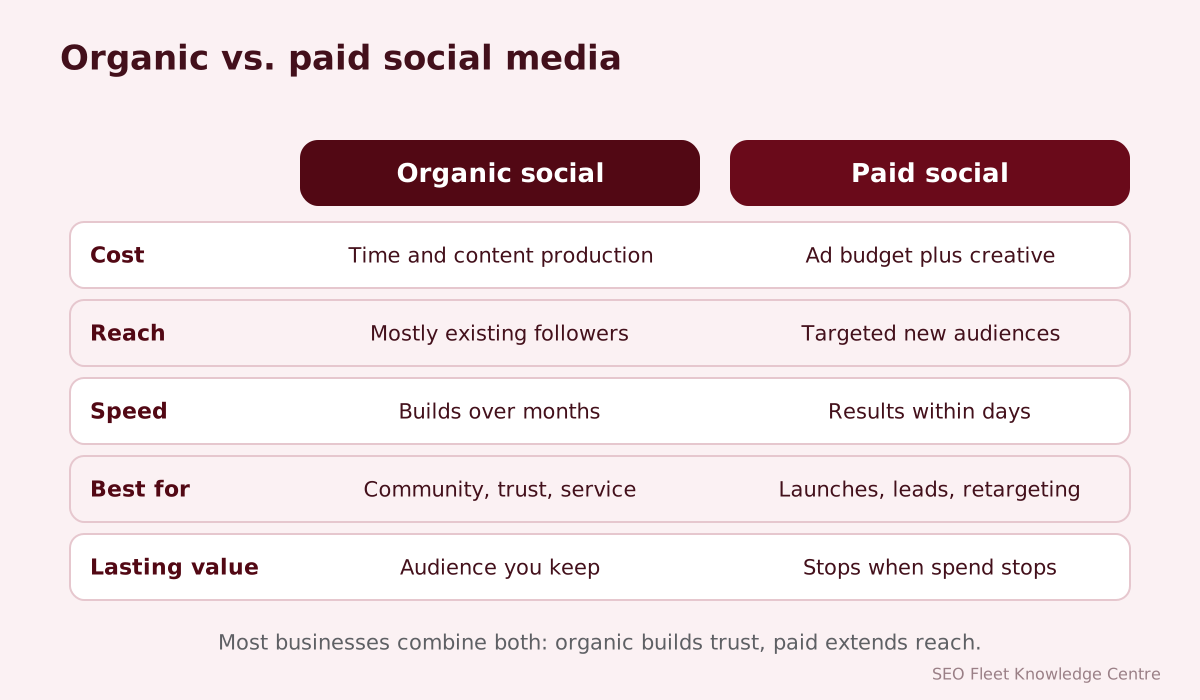
| Organic social | Paid social | |
|---|---|---|
| What it is | Free posts, stories, videos and conversations | Ads you pay to show to chosen audiences |
| Who sees it | Mostly followers, plus shares and recommendations | People you target by location, interests, behavior or lists |
| Cost | Time and content production | Ad spend plus content and management |
| Strengths | Community, trust, customer service | Reach, precise targeting, measurable conversions |
| Limitations | Reach depends on platform algorithms | Stops when spending stops; needs testing |
Most businesses benefit from both: organic content builds credibility, and paid campaigns amplify the best content and reach new customers.
Facebook marketing
Facebook remains one of the broadest platforms, with business Pages, Groups, Messenger, Marketplace and events. It is useful for local businesses, community-focused brands and older audiences. Its biggest business value today is often advertising through Meta Ads Manager, which can target by location, demographics, interests and custom audiences across Facebook and Instagram.
Instagram marketing
Instagram is visual: photos, carousels, Stories and Reels (short vertical video). It suits hospitality, retail, beauty, fitness, design, food, travel and any business with something to show. Instagram profiles also act as a second website for many younger customers, so keep the bio, links and highlights up to date. See Instagram for local businesses.
LinkedIn marketing
LinkedIn is the leading professional network. It suits B2B services, recruitment, professional services and thought leadership. Company pages matter, but posts from founders and team members often reach more people. LinkedIn advertising can target by job title, industry, company size and seniority, which is valuable when you sell to specific roles, although clicks usually cost more than on other platforms. Our LinkedIn marketing guide for B2B goes deeper.
YouTube marketing
YouTube is both a social platform and a search engine for video. How-to content, product demonstrations, reviews and explainer videos can be found for years after publishing. YouTube Shorts compete with other short-form video, while longer videos build deeper understanding and trust. Titles, descriptions, chapters and thumbnails all affect discovery.
TikTok marketing
TikTok is built around short, entertaining, often informal video, discovered through a highly personalized feed rather than followers alone. It rewards authentic, creative content and trends. It suits consumer brands targeting younger audiences, but businesses should check local regulations and their own data and brand policies before investing.
Pinterest marketing
Pinterest is a visual discovery and planning platform where people save ideas for homes, weddings, recipes, fashion, travel and projects. Because people often plan purchases there, it suits home, decor, food, fashion, crafts and wedding businesses. Pins can drive traffic for a long time after posting.
Social media content strategy
A content strategy answers: who are we talking to, what do they care about, what do we want them to do, and what will we post to get there? A practical approach is to choose three to five content pillars, recurring themes such as:
- Educate: tips, how-tos and answers to common questions.
- Show: products, projects, before-and-after results.
- Prove: reviews, case studies, testimonials.
- Humanize: team, behind the scenes, community involvement.
- Offer: promotions, launches and events, used sparingly.
Content calendars
A content calendar plans what will be posted, where and when, usually a month ahead. It makes sure posts are balanced across pillars, aligned with launches and seasons, and approved in advance. It also turns social media from a daily scramble into a predictable task. See our social media content calendar guide.
Graphic design and visual content
Consistent visuals make content recognizable: brand colors, fonts, logo placement and photo style. Real photos of your team, products and work usually outperform generic stock images. Design for mobile screens first, keep text on images short and readable, and add alt text where platforms allow it.
Reels and short-form videos
Short vertical videos (Instagram Reels, YouTube Shorts, TikTok) are now central to reach on many platforms. Effective short videos hook attention in the first seconds, show rather than tell, use captions because many people watch without sound and end with a clear next step. They do not need studio production: a phone, good light and a clear idea are often enough.
Community management
Community management means responding to comments, messages, mentions and reviews, and encouraging conversation. Quick, friendly, helpful replies build trust with everyone watching, not just the person who asked. Set response times, prepare answers to common questions and agree how to handle complaints, for example by moving them to a private message and resolving them quickly.
Social media advertising
Paid social campaigns are built around an objective (such as awareness, traffic, engagement, leads or sales), an audience, a budget and creative (images, videos and copy). Lead form ads let people submit details without leaving the platform. Tracking such as the Meta Pixel and Conversions API connects ads to website actions, subject to consent. See Meta lead generation ads.
Audience targeting
- Core targeting: location, age, interests, behaviors and, on LinkedIn, job and company details.
- Custom audiences: website visitors, video viewers, page engagers or customer lists you have permission to use.
- Lookalike audiences: people similar to an existing audience.
Platforms increasingly rely on automated audience expansion. Strong creative and accurate conversion data now matter as much as manual targeting choices.
Influencer marketing
Influencer marketing means partnering with creators whose audiences trust them. Smaller, specialist creators often deliver more relevant engagement than large celebrities. Choose creators whose audience matches your customers, agree clear deliverables and usage rights, and make sure partnerships are disclosed as advertising rules require (for example, the FTC’s endorsement guidance in the USA).
Social media analytics
Each platform has built-in insights (Meta Business Suite, LinkedIn Page analytics, YouTube Studio, TikTok analytics). Use UTM parameters on links so Google Analytics can show which posts and campaigns sent visitors who converted. Our UTM parameters guide explains how.
Engagement metrics
| Metric | What it tells you |
|---|---|
| Reach | How many unique people saw your content |
| Impressions | How many times it was shown |
| Engagement | Likes, comments, shares, saves and clicks |
| Engagement rate | Engagements ÷ reach (or impressions) × 100 |
| Saves and shares | Content people found valuable enough to keep or pass on |
| Link clicks | Visits generated to your website |
| Video views and watch time | Whether video holds attention |
| Follower growth | Audience growth over time |
Social media ROI
Return on investment is the hardest part of social media to measure, because much of its value is indirect: awareness, trust and recall that lead to searches or recommendations later. Combine several views:
- Direct results: leads, bookings and sales from social traffic and ads, tracked in analytics and ad platforms.
- Cost efficiency: cost per lead and cost per sale from paid social.
- Assisted conversions: visits from social that happened before a later conversion.
- Brand indicators: growth in branded searches, direct traffic and customer mentions.
Our article on measuring social media results covers practical reporting.
Common mistakes
- Being on every platform instead of doing two well.
- Posting only promotions.
- Inconsistent posting followed by long silences.
- Ignoring comments and messages.
- Using generic stock images and no real people.
- Chasing follower counts instead of business results.
- Boosting random posts instead of running planned campaigns.
- No UTM tracking, so results cannot be connected to sales.
Creating a social media marketing plan
- Set goals linked to the business, such as inquiries, bookings or event attendance.
- Define your audience and where they spend time.
- Audit current profiles and competitors.
- Choose platforms and content pillars.
- Create a monthly calendar and a simple approval process.
- Plan community management and response times.
- Decide paid budget and campaign objectives.
- Set up tracking and a monthly report.
- Review and adjust monthly.
Choosing the right platforms
| If your business is… | Start with |
|---|---|
| A local service or shop | Facebook, Instagram, Google Business Profile posts |
| B2B or professional services | LinkedIn, YouTube |
| Visual consumer products | Instagram, Pinterest, TikTok |
| Education, how-to or complex products | YouTube, LinkedIn or Instagram |
| Targeting younger consumers | TikTok, Instagram, YouTube Shorts |
The right answer depends on where your customers actually are. Ask them.
Social media for B2B vs. B2C businesses
| Factor | B2B (business to business) | B2C (business to consumer) |
|---|---|---|
| Main platforms | LinkedIn, YouTube, industry communities | Instagram, Facebook, TikTok, YouTube, Pinterest |
| Who posts best | Founders, experts and employees as well as the brand page | The brand, creators and customers |
| Content that works | Insights, case explanations, events, hiring, industry commentary | Products in use, behind the scenes, offers, entertainment, user content |
| Buying cycle | Longer, several decision makers | Shorter, often impulse or seasonal |
| Typical goal | Credibility, leads, recruitment | Awareness, sales, loyalty |
Handling negative comments and a social media crisis
Every active business eventually receives criticism in public. How you respond is visible to everyone, so it matters more than the original complaint.
- Respond promptly, even if only to acknowledge the issue and say you are looking into it.
- Stay calm and factual. Never argue, mock or reveal a customer’s personal details.
- Move details to a private channel such as direct message, email or phone.
- Follow up publicly when the issue is resolved, if appropriate.
- Know when not to delete. Remove spam, abuse and personal data, but deleting fair criticism usually makes things worse.
- Have an escalation plan for serious issues: who decides, who speaks and who approves statements.
Social media policy and brand safety
A short written policy prevents many problems. It should cover who can post on behalf of the business, approval steps, tone of voice, how to handle complaints, rules for employees mentioning the company personally, and disclosure requirements. In the USA, the Federal Trade Commission’s Endorsement Guides require clear disclosure of material connections, such as paid partnerships or free products given to influencers, and similar rules exist in the UK, EU, Australia and India.
Conclusion
Social media marketing works when it has a purpose: a clear audience, useful and recognizable content, real conversations and a way to measure results. Organic content builds relationships; paid social extends your reach. Focus on fewer platforms, done consistently, and connect your activity to business outcomes.
SEO Fleet offers social media marketing, social media advertising and platform-specific services for Facebook, Instagram and LinkedIn.


