


When people need a product, a service or an answer, most of them start with a search. They type a few words into Google or Bing, or ask a question out loud, and choose from what appears. If your business is not visible at that moment, the customer meets your competitors instead.
Search engine optimization (SEO) is the work of improving a website so that it appears more often, and in better positions, in the unpaid results of search engines. This guide explains how search engines work, what SEO involves, how long it takes and how to tell whether it is working. SEO Fleet started as an SEO company in 2007, and we have watched the field change through every major Google update, so we will also point out which old habits no longer help.
What is search engine optimization?
SEO is the process of making a website easier for search engines to find, understand and trust, and more useful for the people who arrive from search. It combines technical work, content and reputation-building.
Organic results vs. paid ads
A typical Google results page contains two kinds of listings:
- Paid results are advertisements, labeled “Sponsored.” Advertisers pay when someone clicks. They disappear when the budget stops.
- Organic results are the unpaid listings Google selects as the most relevant and useful. You cannot pay Google to rank higher here. Google states that it does not accept payment to crawl a site more often or rank it higher.
SEO is about the organic results, plus related features such as map results, images, videos and AI-generated summaries.
How do search engines work?
Google describes its process in three stages. Understanding them explains most of what SEO does.
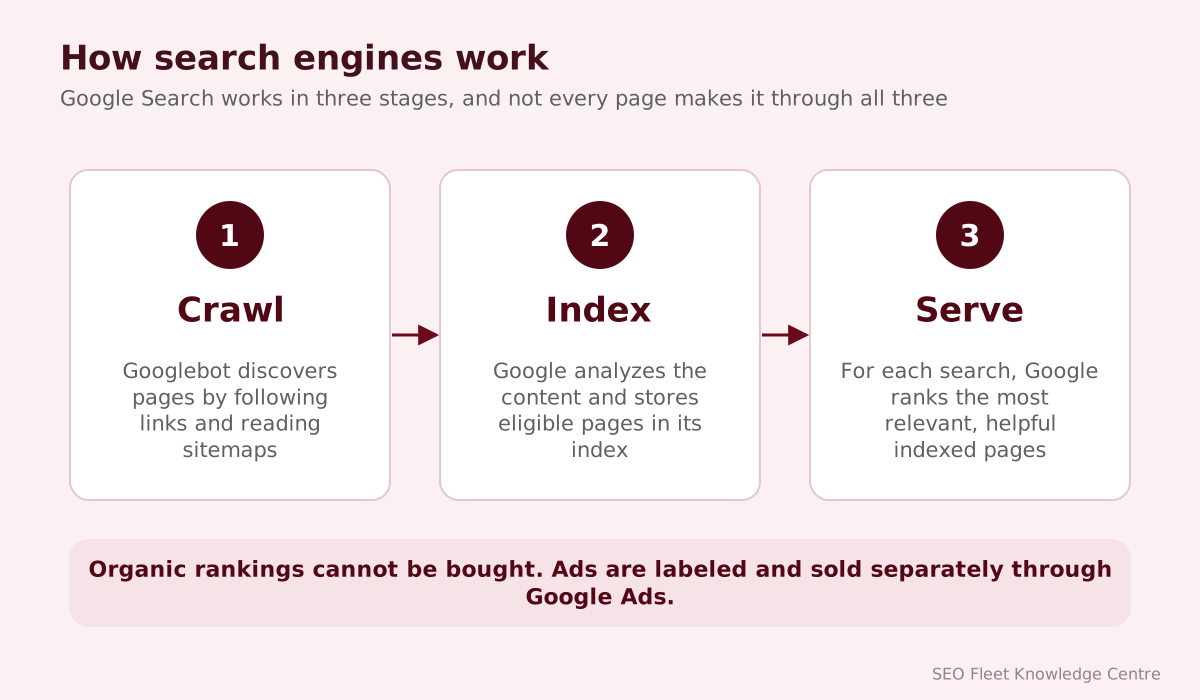
- Crawling. Automated programs called crawlers (Google’s is Googlebot) visit pages and download their content. There is no central register of web pages, so crawlers discover new URLs mainly by following links from pages they already know and by reading XML sitemaps that site owners submit.
- Indexing. Google analyzes each page’s text, title, images, videos and structure, and stores what it learns in its index, an enormous database. When several pages are very similar, Google picks one as the canonical version to show. Not every crawled page is indexed.
- Ranking (serving results). When someone searches, Google selects the indexed pages it considers most relevant and helpful for that query, taking into account factors such as the searcher’s location, language and device.
A simple example
A bakery publishes a new page about wedding cakes. Googlebot finds it because the homepage links to it and it is listed in the sitemap. Google indexes it and understands it is about wedding cakes in a particular city. When someone in that city searches “wedding cake bakery,” the page competes with every other relevant page, and Google decides the order. If the page were blocked by robots.txt, hidden behind a login or not linked from anywhere, it might never get past the first stage.
Why is SEO important?
- Organic visibility: you appear for the searches your customers actually make.
- Qualified traffic: searchers are already looking for what you offer, so they are more likely to inquire or buy.
- Credibility: many people trust organic results and well-reviewed local listings.
- Customer acquisition: every ranking page can generate leads around the clock without a cost per click.
- Long-term value: good content and a healthy site keep working long after the work is done, unlike ads that stop when the budget does.
- Competitive advantage: rankings are hard to copy quickly, so early, consistent work compounds.
Types of SEO
| Type | Objective | Typical activities |
|---|---|---|
| On-page SEO | Make each page relevant and useful for its search | Keyword research, titles, headings, content, internal links |
| Off-page SEO | Build authority and reputation beyond your site | Earning links, digital PR, reviews, brand mentions |
| Technical SEO | Help search engines crawl, render and index the site | Site structure, speed, sitemaps, redirects, structured data |
| Local SEO | Appear in map and local results | Google Business Profile, reviews, citations, location pages |
| Ecommerce SEO | Rank category and product pages | Category structure, product content, faceted navigation, product schema |
| International SEO | Show the right version to each country or language | Hreflang, country targeting, localized content |
| Enterprise SEO | Manage SEO across very large sites and teams | Templates, governance, automation, log analysis |
Most businesses need on-page, technical and off-page SEO. Local, ecommerce and international SEO apply when the business model calls for them.
Important on-page SEO factors
- Keyword research: finding the words people use to search for your products and services (covered in detail below).
- Search intent: matching the page to what the searcher actually wants. Someone searching “how to fix a leaking tap” wants instructions; someone searching “plumber near me” wants to hire one.
- Title tags: the clickable headline in search results. Make each one unique, descriptive and concise.
- Meta descriptions: the short summary under the title. Google does not use it for ranking, but a clear one can earn more clicks.
- Heading structure: one clear H1 for the page, then H2 and H3 headings that organize sections logically.
- Content optimization: cover the topic thoroughly and accurately, in plain language, with original detail and experience. Google’s guidance asks whether content provides original information and would be worth bookmarking or recommending.
- Internal linking: link related pages with descriptive anchor text so visitors and crawlers can find them.
- URL structure: short, readable URLs such as
/services/roof-repair/. - Image optimization: compressed images, descriptive file names and alt text that describes the image.
- User experience: fast loading, easy navigation, readable text and clear calls to action.
Technical SEO explained
Technical SEO makes sure search engines can access and understand your site. You may never see these issues, but they can stop good content from ranking.
| Element | What it does |
|---|---|
| Crawling | Search engines must be able to reach your pages through links |
| Indexability | Pages must not be blocked by “noindex” tags or errors if you want them in results |
| XML sitemaps | A file listing important URLs to help search engines discover them |
| Robots.txt | A file that tells crawlers which areas not to crawl. It is not a way to hide pages from results |
| Canonical tags | Indicate the preferred version when similar pages exist |
| HTTPS | Encrypts the connection and is expected of every site |
| Redirects | Send visitors and search engines from old URLs to new ones (use permanent 301 redirects for moved pages) |
| Structured data | Code that describes content (products, FAQs, events) and can make pages eligible for rich results |
| JavaScript SEO | Ensures content loaded by JavaScript can be rendered and indexed |
| Mobile usability | Google uses the mobile version of a site for indexing, so it must work well on phones |
| Core Web Vitals | Google’s page experience measures: LCP 2.5 seconds or less, INP 200 milliseconds or less, CLS 0.1 or less |
Our guide to Core Web Vitals and our guide to reading a technical SEO audit go deeper.
Off-page SEO
Off-page SEO covers signals that come from outside your website:
- Backlinks: links from other websites to yours. Links help search engines discover pages and can act as a sign of trust.
- Link building: the work of earning those links, for example by creating useful resources and contacting relevant sites.
- Digital PR: earning coverage from news and industry publications.
- Brand mentions: people discussing your business online, linked or not.
- Guest contributions: genuinely useful articles written for relevant publications.
- Online reputation: reviews and ratings across Google and industry platforms.
- Industry citations: accurate listings in relevant directories and associations.
Quality beats quantity. In 2007 it was common to submit sites to hundreds of directories. That no longer helps and can harm. Google’s spam policies specifically name buying links that pass ranking credit, excessive link exchanges, automated link building and keyword-stuffed guest post campaigns. One relevant link from a respected industry site is worth more than hundreds of low-quality ones. See does link building still work in 2026?
Keyword research
A keyword is the word or phrase someone types (or says) into a search engine. Keyword research finds which ones matter to your business.
- Short-tail keywords are broad, such as “running shoes.” High demand, high competition, mixed intent.
- Long-tail keywords are specific, such as “women’s trail running shoes for wide feet.” Lower volume, clearer intent, often easier to rank for.
| Intent | The searcher wants to… | Example | Best page type |
|---|---|---|---|
| Informational | Learn something | “what is a heat pump” | Guide or article |
| Navigational | Reach a specific site | “SEO Fleet login” | Homepage or specific page |
| Commercial | Compare options | “best accounting software for freelancers” | Comparison or service page |
| Transactional | Buy or book | “book boiler service Leeds” | Service, product or booking page |
Search volume estimates how often a keyword is searched each month. Keyword difficulty is a tool’s estimate of how hard it is to rank. Both come from third-party tools and are estimates, not Google data. Keyword mapping assigns each important keyword group to one page, so pages do not compete with each other. Our article on keyword research that finds buyers shows the process.
SEO content strategy
- Content planning: list the questions customers ask at each stage, from first research to final decision.
- Topic clusters: group related content around a central subject.
- Pillar pages: a comprehensive page covering the main topic (like this guide).
- Supporting articles: narrower pieces that go deeper on subtopics and link back to the pillar.
- Content optimization: improve existing pages that rank on page two before writing new ones.
- Content updates: refresh facts, examples and screenshots so pages stay accurate.
- Internal linking: connect the cluster so readers and crawlers move easily between related pages.
Read what is content marketing for the bigger picture.
Local SEO
For businesses serving a local area, the map results are often the most valuable part of the page. Google says local rankings are based mainly on relevance, distance and prominence, and that you cannot pay for a better local ranking. The essentials:
- A complete, verified Google Business Profile with the correct categories.
- The same business name, address and phone number everywhere it appears online.
- A steady flow of genuine reviews, with replies.
- Useful location pages and local citations.
Our complete guide to local SEO covers each step.
How long does SEO take?
There is no fixed timeline, and anyone who promises one should be treated with caution. Technical fixes can show effects within weeks once pages are recrawled. Meaningful growth in competitive markets usually builds over several months to a year. The main factors:
- Competition: ranking for “lawyer New York” is a very different task from ranking for a niche product.
- Website history: established sites with a good reputation usually move faster than new domains.
- Technical condition: serious crawl or indexing problems must be fixed before content can perform.
- Content quality: genuinely useful, original content earns visibility; thin pages rarely do.
- Consistency: SEO done steadily for a year beats bursts of activity.
How is SEO performance measured?
Two free tools from Google are essential:
- Google Search Console shows how your site appears in Google Search: impressions (how often you appeared), clicks, CTR (clicks divided by impressions) and average position, by page and by query. It also reports indexing problems.
- Google Analytics 4 shows what visitors do after they arrive: engagement, conversions, leads and revenue from organic search.
Good SEO reporting connects visibility to business results: organic clicks, keyword visibility for priority topics, organic conversions, leads and revenue. Rankings alone are not the goal. Our Google Search Console guide walks through the reports.
Common SEO mistakes
- Keyword stuffing: repeating phrases unnaturally makes pages worse and can break Google’s spam policies.
- Duplicate content: many near-identical pages (for example, location pages with only the town name changed) dilute visibility.
- Poor-quality backlinks: bought or automated links risk penalties.
- Ignoring technical SEO: great content cannot rank if it is not indexed.
- Poor site architecture: important pages buried many clicks deep get less attention.
- Thin content: short, generic pages written only to target a keyword.
- Ignoring mobile users: Google indexes the mobile version of your site.
- Buying guaranteed rankings: Google warns that no one can guarantee a #1 ranking.
- Neglecting updates: outdated pages lose trust and traffic over time.
SEO vs. PPC
| SEO | PPC | |
|---|---|---|
| Cost model | Investment in work; no cost per click | Pay for each click |
| Speed | Builds over months | Visibility within days |
| Durability | Continues after work slows | Stops when budget stops |
| Control | Google decides rankings | You control keywords, budget and messages |
| Best for | Long-term, cost-efficient visibility | Fast leads, testing, seasonal offers |
They work well together: PPC can test which keywords convert while SEO builds; SEO reduces reliance on paid clicks over time. See what is PPC advertising.
DIY SEO vs. professional SEO services
What you can do yourself: set up Search Console and Analytics, complete your Google Business Profile, write clear titles and helpful pages based on customer questions, ask for reviews and keep your site updated. Google’s SEO Starter Guide is an excellent free resource.
When specialist help is worth it: when competition is strong, when there are technical problems (migrations, indexing issues, JavaScript sites), when you need a content and link strategy at scale, or when your time is better spent running the business. When choosing an SEO provider, be wary of guarantees and of anyone claiming special access to Google. Ask how they will report results and what they will actually do each month.
Conclusion
SEO is not a one-time setting. It is an ongoing process of keeping your site technically healthy, publishing genuinely useful content, earning a good reputation and learning from your data. Businesses that treat it as a long-term investment, and stay away from shortcuts, build a source of customers that keeps working.
SEO Fleet has provided SEO services since 2007, including technical SEO, on-page SEO and link building. A good first step is a free SEO audit of your website.


