


Before people contact a business, they usually want answers. How much does this cost? Which option is right for me? What could go wrong? Who can I trust? Businesses that answer those questions clearly, honestly and in the places people look tend to earn the inquiry. That is the idea behind content marketing.
This guide explains what content marketing is, why it works, the main content types, how to plan and create content, how to distribute it and how to measure whether it is paying off. It also covers how to use AI tools responsibly in content production.
What is content marketing?
Content marketing is creating and sharing useful, relevant content (articles, guides, videos, tools, case studies, newsletters) to attract a defined audience, build trust and ultimately encourage profitable action. Instead of interrupting people with ads, content marketing earns attention by being worth reading or watching.
Content marketing is not the same as producing lots of blog posts. One genuinely helpful guide that answers a common customer question can outperform fifty generic articles.
How content marketing works
- Understand the audience: their questions, problems and the words they use.
- Create content that helps: answers, explanations, comparisons, examples and tools.
- Get it discovered: search engines, social media, email, partners and PR.
- Build trust: people return, subscribe, share and remember your name.
- Guide the next step: relevant calls to action move readers toward inquiry or purchase.
- Measure and improve: see which content brings visitors and leads, and update or expand it.
Why businesses need content marketing
- Search visibility: content gives search engines pages to rank for the questions customers ask. See what is SEO.
- Trust and authority: clear explanations show expertise before a sales conversation.
- Shorter sales cycles: leads arrive better informed, with fewer basic questions.
- Material for every channel: one strong guide can feed social posts, emails, videos and sales presentations.
- Lasting value: a well-maintained guide can keep attracting visitors for years.
- Links and mentions: genuinely useful resources are what other sites link to.
Types of content
| Type | What it is | Good for |
|---|---|---|
| Blog articles | Focused posts on specific topics or questions | Search visibility, answering common questions |
| Website content | Service, product, about and location pages | Explaining your offer and converting visitors |
| Videos | How-tos, demonstrations, explainers, stories | Showing products and people, YouTube search |
| Infographics | Visual explanations of data or processes | Simplifying complex topics, earning shares |
| Case studies | Real client problems, solutions and results | Proof at the decision stage |
| Whitepapers | In-depth reports on a topic or problem | B2B credibility and lead generation |
| Guides | Comprehensive, structured resources | Authority and long-term traffic |
| Podcasts | Audio conversations and interviews | Relationships and thought leadership |
| Email newsletters | Regular updates to subscribers | Retention and repeat visits |
The content marketing funnel
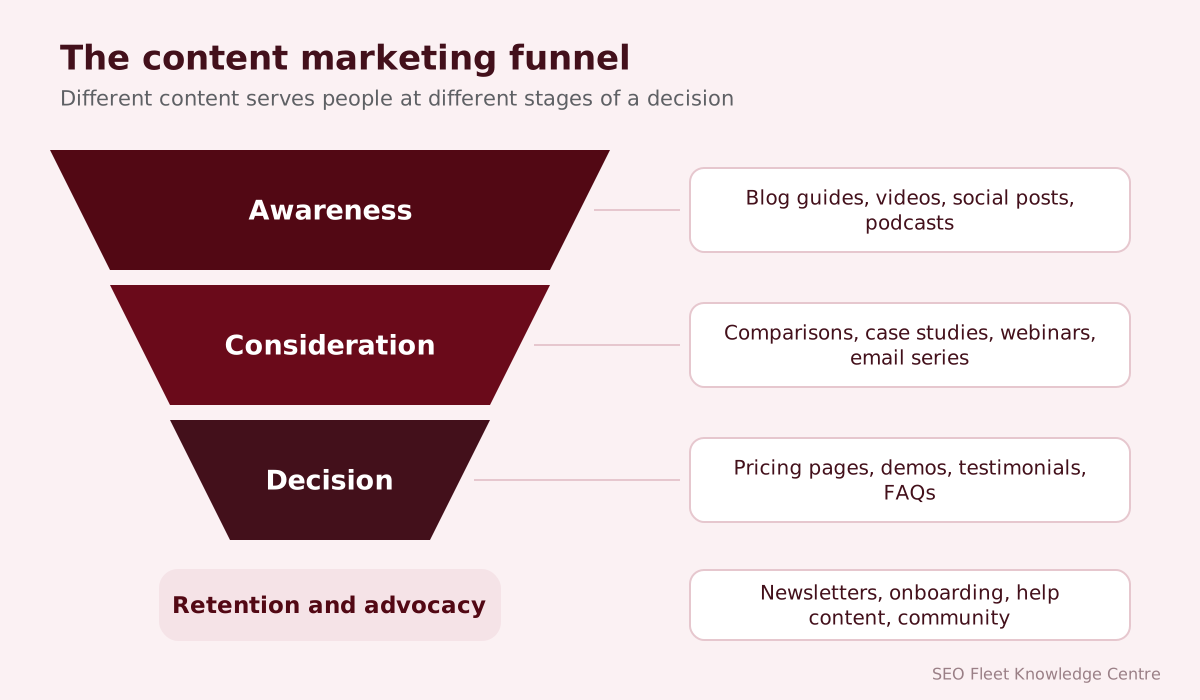
- Awareness (top of funnel): people are learning about a problem. Content: explainers, how-to guides, checklists, short videos. Example: “What causes damp in houses?”
- Consideration (middle): people are comparing solutions. Content: comparisons, buying guides, case studies, webinars. Example: “Damp-proof course vs. tanking: which do you need?”
- Decision (bottom): people are choosing a provider. Content: service pages, pricing, reviews, guarantees, FAQs. Example: “Damp proofing services in Leeds.”
- Retention and advocacy: customers need help and reasons to return. Content: newsletters, help articles, onboarding guides.
Content strategy
A content strategy is a documented plan for what content to create, for whom, why and how it will be measured. It should include:
- Goals: for example, more organic leads for a specific service.
- Audience: who you are writing for and what they need.
- Topics and formats: what you will cover and how.
- Voice and standards: tone, spelling, accuracy checks and who reviews what.
- Distribution: where each piece will be promoted.
- Measurement: how success will be judged.
Our content strategy that drives leads guide includes a template.
Audience research
The best content ideas come from real conversations. Practical sources:
- Questions customers ask sales and support staff.
- Emails, chat transcripts and reviews (yours and competitors’).
- Search Console queries your site already appears for.
- Forums, social media comments and industry communities.
- Short customer interviews or surveys.
See finding blog topics from customer questions.
Keyword research and content planning
Keyword research shows how people phrase those questions in search and how often they search. Use it to prioritize topics, choose clear titles and match search intent: if the results for a query are mostly step-by-step guides, a sales page will struggle to rank for it. Assign each main topic to a single page to avoid several pages competing for the same searches.
Topic clusters
A topic cluster is a group of related content: a broad pillar page covering a main subject, linked to several supporting articles that go deeper into subtopics. For example, a pillar on “home solar panels” might link to articles on costs, installation, maintenance and financing. Clusters help readers explore, make site structure clearer to search engines and show depth of expertise. This Knowledge Centre is organized the same way.
The content creation process
- Brief: audience, goal, search intent, key questions, internal links and call to action.
- Research: official sources, your own experience and data, expert input.
- Outline: a logical structure of headings before writing.
- Draft: clear, specific writing with examples.
- Edit: accuracy, clarity, tone, length, spelling and readability.
- Expert review: essential for technical, medical, legal or financial topics.
- Design and publish: images, diagrams, formatting, metadata.
- Promote and measure.
SEO content optimization
- A specific, accurate title and a single clear H1.
- Headings that reflect the questions readers ask.
- Direct answers early, followed by detail and examples.
- Original value: experience, data, examples or a clearer explanation than what already exists.
- Internal links to related content and relevant service pages.
- Descriptive image alt text and compressed images.
- Visible author and update information, so readers know who wrote it and when.
Google’s guidance on helpful, people-first content suggests asking who created the content, how it was created and, most importantly, why. If the main reason is to attract search traffic rather than help people, it is the wrong reason.
Content distribution
- Owned channels: your website, email list, social profiles.
- Earned channels: links, shares, mentions and press coverage.
- Paid channels: promoting strong content through social ads or search ads.
- Partnerships: industry associations, partners’ newsletters, guest contributions.
- Sales enablement: giving the sales team content to send prospects.
Creating content without distributing it is like opening a shop without a sign.
Content repurposing
Repurposing turns one strong piece into many formats. A detailed guide can become a short video, a carousel post, an email series, a webinar, a checklist download and quotes for social media. It saves time and reaches people who prefer different formats.
AI-assisted content creation and human editorial review
AI writing tools can speed up research, outlining, summarizing and first drafts. They also make confident mistakes, produce generic text and cannot draw on your real experience. Google’s guidance focuses on the quality and purpose of content rather than how it is produced, but it warns that generating many pages primarily to manipulate rankings is spam (“scaled content abuse”).
How we use AI at SEO Fleet: for research support, outlines and editing suggestions, never as a replacement for subject knowledge. Every fact is checked against a reliable source, every piece is edited by a person, and nothing is published that we would not put our name to. See AI content creation without losing quality.
Measuring content performance
| Goal | Useful measures |
|---|---|
| Visibility | Impressions, clicks and queries in Google Search Console |
| Engagement | Engaged sessions, scroll depth, time on page, returning visitors |
| Leads | Conversions from content pages, assisted conversions, newsletter sign-ups |
| Authority | Links and mentions earned |
| Sales support | Content used by sales, content viewed by leads before buying |
Review older content regularly: updating a page that already ranks on page two is often faster than writing a new one. See refreshing old content.
Common content marketing mistakes
- Writing about what the business wants to say rather than what customers ask.
- Publishing thin, generic articles to hit a posting schedule.
- Ignoring search intent.
- No calls to action or internal links.
- Never updating content after publishing.
- Publishing unchecked AI text with errors.
- Measuring pageviews only, not leads or sales influence.
- Creating content but not distributing it.
Building a content calendar
A content calendar lists each planned piece with its topic, format, target keyword or question, funnel stage, author, due date, publication date and distribution plan. Plan a quarter ahead, leave room for timely topics, and balance new content with updates to existing pages. A simple spreadsheet is enough to start.
Content marketing ROI
Content marketing return on investment compares the value content generates with its cost. A simple approach:
- Add up costs: writing, editing, design, video, tools and promotion.
- Track leads and sales from content pages, directly and as assisted conversions in Google Analytics.
- Estimate value: leads × lead-to-customer rate × average customer value.
- Calculate ROI: (value − cost) ÷ cost × 100.
Example: a set of guides costs $3,000 to produce and brings 30 leads in six months; 5 become customers worth $1,500 each ($7,500). ROI is (7,500 − 3,000) ÷ 3,000 = 150%, and the guides keep working afterwards. Content ROI usually grows over time, so judge it over months, not weeks.
Content formats compared
| Format | Effort to produce | Lifespan | Strengths |
|---|---|---|---|
| Blog articles and guides | Medium | Long, especially when updated | Search visibility, depth, easy to link to |
| Videos | Medium to high | Long on YouTube, short on social feeds | Demonstration, personality, trust |
| Case studies | Medium | Long | Proof for buyers close to a decision |
| Email newsletters | Low to medium | Short | Direct relationship, repeat visits |
| Podcasts | Medium to high | Long | Depth, loyal listeners, guest relationships |
| Tools and calculators | High | Very long | Usefulness, links, repeat use |
| Social posts | Low | Very short | Reach, conversation, distribution of other content |
Updating and pruning existing content
For an established site, improving what already exists often delivers more than publishing something new. Review your content at least once a year:
- Update pages with outdated facts, prices, screenshots or recommendations, and change the updated date only when the change is meaningful.
- Merge several thin articles on the same topic into one stronger guide, and redirect the old URLs.
- Improve pages that get impressions in Search Console but few clicks, by making titles and introductions clearer and answers more complete.
- Retire content that is no longer accurate or relevant and has no visitors or links, with a redirect where a relevant page exists.
Showing experience and expertise in your content
Google’s guidance on helpful content asks whether content demonstrates first-hand experience and expertise. Practical ways to do that include naming the author and their background, using your own photos, explaining how you tested or evaluated something, sharing real (anonymized where necessary) examples from your work, citing reliable sources and being clear about limitations. These signals help readers decide whether to trust you, which is the real point.
Conclusion
Content marketing works because it gives people what they are looking for: clear, trustworthy answers. Build it on real customer questions, match search intent, add your own expertise, distribute it well and keep it up to date. Over time, it becomes one of the most valuable assets a business owns.
SEO Fleet provides content marketing, content strategy, SEO content writing and blog writing services, written by people and grounded in research.


