


Artificial intelligence has moved from research labs into everyday business software in just a few years. Many people now draft emails with an AI assistant, search engines show AI-generated summaries, and marketing platforms use AI to decide who sees which ad. For business owners, the questions are practical: what is AI really, what can it do for my business, what are the risks, and where should I start?
This guide answers those questions in plain language. It explains how AI works, the main types, how businesses use it in operations, marketing and websites, how it is changing search, and how to adopt it responsibly. SEO Fleet uses AI tools in our own work and helps clients implement them, so the advice here comes from practice, not hype.
Introduction to artificial intelligence
What is AI?
Artificial intelligence (AI) is the field of computer science that builds systems able to perform tasks that normally require human intelligence: understanding language, recognizing images, finding patterns, making predictions, generating text or images, and making decisions. Most AI in use today is software that has learned patterns from large amounts of data rather than following rules written line by line.
How does artificial intelligence work?
At a high level, modern AI systems are trained on examples. A model is shown large amounts of data (text, images, transactions, sensor readings) and adjusts millions or billions of internal parameters until it becomes good at a task, such as predicting the next word in a sentence or classifying an image. Once trained, the model applies those learned patterns to new inputs.
How AI has evolved
- 1950s to 1980s: early AI relied on hand-written rules and logic (“expert systems”).
- 1990s to 2000s: machine learning grew, with systems learning patterns from data, for example spam filters and recommendation engines.
- 2010s: deep learning, powered by more data and faster chips, transformed image recognition, speech recognition and translation.
- 2017 onward: the “transformer” architecture enabled large language models.
- 2020s: generative AI tools became widely available to the public and to businesses, followed by AI agents that can carry out multi-step tasks.
Traditional software, automation, machine learning and AI
| Approach | How it works | Example |
|---|---|---|
| Traditional software | Follows rules written by programmers | An invoice calculator |
| Automation | Runs predefined steps automatically | Sending an email when a form is submitted |
| Machine learning | Learns patterns from data to predict or classify | Flagging likely fraudulent transactions |
| Generative AI | Creates new text, images, audio or code from patterns learned in training | Drafting a product description |
AI is a broad umbrella. Machine learning is the main way AI is built today, and generative AI is one branch of it.
Understanding different types of AI
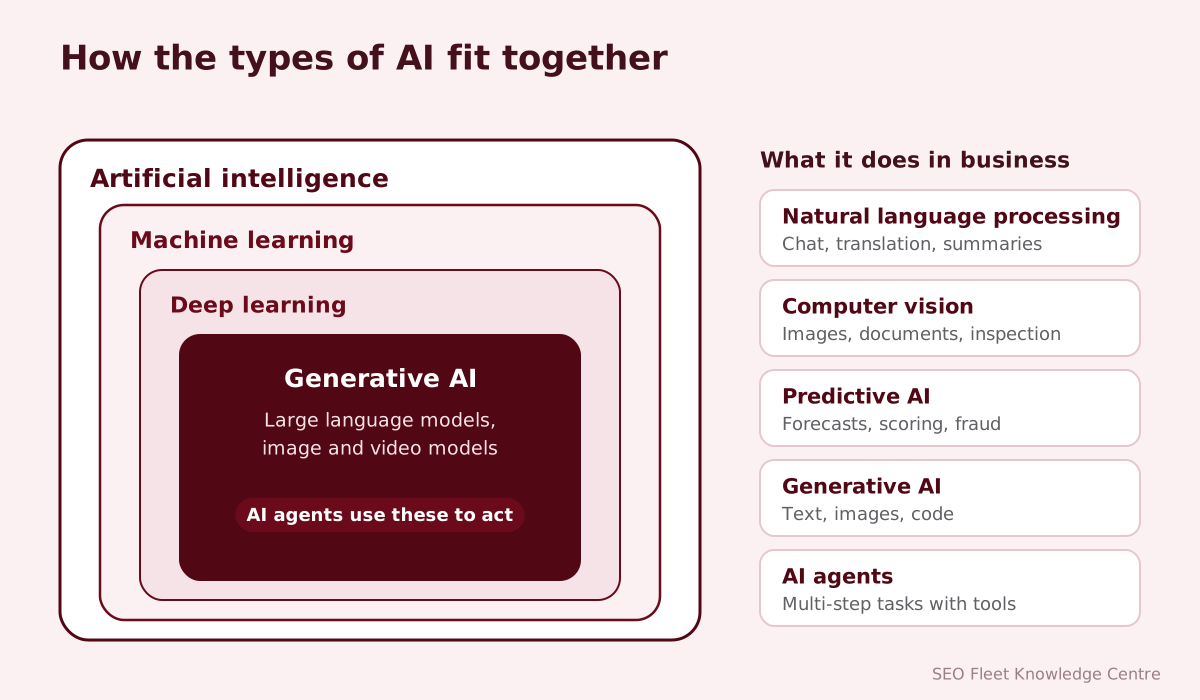
- Narrow AI: systems designed for specific tasks, such as recommending products or transcribing speech. All AI in business use today is narrow AI; it does not “understand” the world the way people do.
- Machine learning: algorithms that learn from data to make predictions or decisions without being explicitly programmed for every case.
- Deep learning: machine learning using many-layered neural networks, especially powerful for images, speech and language.
- Natural language processing (NLP): understanding and generating human language: chatbots, translation, sentiment analysis, summarization.
- Computer vision: interpreting images and video: quality inspection, document scanning, product recognition.
- Predictive AI: forecasting outcomes from historical data: demand, churn, lead quality.
- Generative AI: creating new content such as text, images, audio, video or code. Large language models (LLMs) power chat assistants.
- Agentic AI and AI agents: systems that can plan and carry out multi-step tasks using tools (searching, filling forms, updating records) with some autonomy. They are powerful but need careful limits and oversight.
How AI works
Data collection and processing
AI depends on data. Training data must be relevant, large enough and as accurate and unbiased as possible. Poor data produces poor AI, a principle often summarized as “garbage in, garbage out.”
Training models
During training, a model makes predictions, compares them with correct answers and adjusts itself to reduce errors, repeated many millions of times. Large models are trained once by AI companies at great cost; businesses usually use them through apps and APIs, sometimes customizing them with their own documents.
Algorithms and neural networks
A neural network is a set of connected mathematical functions loosely inspired by the brain. Each connection has a weight that changes during training. Deep networks with many layers can learn very complex patterns, such as grammar or the features of a face.
Prompts and user instructions
Generative AI tools respond to prompts: instructions written by the user. Clear prompts with context, examples, constraints and the desired format produce much better results than vague requests. For example, “Write a 120-word product description for a waterproof hiking boot, for experienced hikers, in a practical tone, in US English” works far better than “write a description.”
AI-generated results and limitations
Generative AI predicts plausible outputs; it does not check facts the way a person would. It can produce confident but incorrect statements (often called hallucinations), outdated information, biased outputs and generic writing. It lacks your business context unless you provide it. Its outputs must be reviewed.
How businesses can use AI
| Area | Example uses |
|---|---|
| Customer support and chatbots | Answering common questions, triaging tickets, after-hours help with handover to staff |
| Marketing automation | Segmenting audiences, timing emails, drafting variations |
| Sales and lead generation | Scoring leads, summarizing calls, drafting follow-ups |
| Data analysis and forecasting | Spotting trends, forecasting demand, explaining reports |
| Website personalization | Recommending products or content |
| Document processing | Extracting data from invoices, contracts and forms |
| Workflow automation | Routing requests, updating records, generating routine documents |
| Business intelligence | Asking questions of business data in plain language |
Example: a property management firm receives hundreds of maintenance emails a week. An AI workflow reads each email, categorizes the issue and urgency, drafts a reply and creates a ticket for the right contractor. Staff review and send. Response times fall and nothing is lost in the inbox. See automating repetitive business tasks with AI.
AI in digital marketing
- AI-assisted SEO research: grouping keywords by topic, summarizing competitor content, finding questions to answer.
- Keyword and search intent analysis: classifying large keyword lists by intent and funnel stage.
- Content planning and optimization: outlines, briefs and suggestions for clarity, always checked and finished by people.
- Advertising campaign optimization: Google Ads and Meta use machine learning for bidding, targeting and ad combinations. Results depend on accurate conversion data.
- Social media management: drafting captions, repurposing content, analyzing engagement.
- Email personalization: product recommendations, send-time optimization and subject line testing.
- Customer behavior analysis: identifying patterns in purchases and website journeys.
- Conversion rate optimization: analyzing session recordings and feedback to find friction points.
SEO Fleet perspective: AI makes good marketers faster; it does not make weak strategy better. The businesses we see benefiting most use AI for research, first drafts and analysis, and keep people responsible for facts, judgment and brand voice. Read AI content creation without losing quality.
AI and website development
- AI-assisted design: generating layout ideas, images and early concepts for discussion.
- AI coding assistants: suggesting code, explaining errors and writing tests. They speed up developers but can produce insecure or incorrect code, so review is essential.
- Website chatbots: answering visitor questions from your own content, with a clear route to a human. See AI chatbots for customer service.
- Automated testing: generating test cases and checking for broken functionality.
- Personalization and UX: tailoring content or recommendations to visitors.
Opportunities and limitations: AI can shorten development time and improve support, but it cannot replace understanding your users, accessibility and security expertise, or accountability for what goes live.
AI and the future of search
AI Overviews and AI Mode
Google now shows AI Overviews, AI-generated summaries with links to sources, for some searches. AI Mode, introduced in the USA in 2025 and expanded since, offers a more conversational, in-depth AI search experience. Other tools such as ChatGPT, Gemini, Copilot and Perplexity also answer questions with cited sources.
Conversational search
People increasingly ask longer, more natural questions and follow-ups, rather than typing two or three keywords. Content that clearly answers real questions, with depth and context, fits this behavior.
Answer Engine Optimization (AEO) and Generative Engine Optimization (GEO)
These terms describe efforts to appear in AI-generated answers. It is important to separate official guidance from marketing claims. Google’s own documentation on optimizing for its generative AI features states that optimizing for generative AI search is still SEO. It says no special schema markup is required, that Google Search does not use files such as llms.txt, and it warns against rewriting or “chunking” content specifically for AI systems. Google also cautions businesses to evaluate third-party AEO and GEO services against its guidance.
Why traditional SEO fundamentals still matter
According to Google, to be eligible for its AI features a page must be indexed and eligible to appear in Search with a snippet, and the site must be included in generative AI features in Search Console. The recommended approach is the familiar one: create valuable, original content with a genuine point of view, organize it clearly, meet technical requirements, keep business and product information accurate (for example in Google Business Profile and Merchant Center) and measure performance in Search Console.
How businesses can prepare their websites
- Publish original, experience-based content that answers your customers’ real questions.
- Make sure important pages are crawlable, indexable and fast.
- Keep business information consistent across your website, Google Business Profile and directories.
- Earn genuine reviews and mentions on trusted sites.
- Use structured data where it supports rich results, as part of normal SEO.
- Monitor performance in Search Console, including its generative AI reporting where available.
See also SEO in the age of AI Overviews.
Popular AI tools and their applications
| Category | Examples | Typical business use |
|---|---|---|
| General-purpose AI assistants | ChatGPT, Claude, Gemini, Microsoft Copilot | Drafting, summarizing, brainstorming, analysis |
| Writing and research | AI features in Google Docs, Microsoft 365, Notion, Grammarly | Editing, summarizing, research support |
| Image and video generation | Adobe Firefly, Canva AI tools, Midjourney, video generators | Concepts, social visuals, simple video edits |
| AI-powered analytics | GA4 insights, Power BI Copilot, spreadsheet AI features | Finding trends, explaining reports |
| Coding assistants | GitHub Copilot and similar tools | Code suggestions, tests, explanations |
| Marketing automation | AI features in HubSpot, Klaviyo, Google Ads, Meta Ads | Segmentation, bidding, creative variations |
Tools change quickly. Choose based on the task, data security terms, integration with your systems and cost, not brand popularity.
Benefits of AI for small and medium-sized businesses
- Time saved on drafting, summarizing and repetitive admin.
- Faster responses to customers and leads.
- Better use of data without hiring a data team.
- More consistent processes, with fewer things forgotten.
- Access to capabilities once limited to large companies, at subscription prices.
Risks, limitations and responsible AI use
- Incorrect or fabricated information: AI can invent facts, sources and figures. Verify everything that matters.
- Data privacy and security: do not paste confidential, personal or client data into tools without checking their data handling terms and your obligations under laws such as GDPR. Prefer business plans with clear data protections.
- Copyright and intellectual property: rules on AI-generated content and training data are still developing and differ by country. Avoid reproducing others’ protected work, and check tool terms.
- Human review and accountability: a person must remain responsible for decisions and published content.
- Overdependence: keep skills and processes that work if a tool changes or fails.
- Content quality: generic AI text adds little value. Google’s spam policies treat mass-produced content made primarily to manipulate rankings as scaled content abuse, however it is created.
- Bias: AI can reflect biases in its training data, which matters in hiring, lending and customer decisions.
Read using AI responsibly: privacy, accuracy and trust.
How to start using AI in your business
- Identify repetitive tasks: list tasks that are frequent, time-consuming and rule-based, such as summarizing meetings, answering common emails or extracting invoice data.
- Choose suitable tools: start with AI features in software you already use before buying new platforms.
- Start with small workflows: pilot one process with a few people.
- Measure time and cost savings: compare time taken and error rates before and after.
- Maintain human oversight: define who reviews outputs and what AI must never do alone.
- Write a simple AI policy: approved tools, what data may be used, review requirements and disclosure.
- Train your team: good prompting and critical review are learnable skills.
Conclusion: AI as a business tool, not a replacement for business thinking
AI is a powerful set of tools for language, images, patterns and automation. Used well, it saves time, improves service and helps small teams do more. It still depends on good data, clear instructions, human judgment and accountability. Businesses that treat AI as an assistant to skilled people, rather than a shortcut around them, will get the most from it.
SEO Fleet offers AI consulting, AI automation, AI chatbots and AI training for teams that want practical, responsible results.


