


Few SEO topics produce as much confident and contradictory advice as link building. Some people say backlinks are the most important ranking factor; others say they no longer matter now that search engines use AI. Business owners are left wondering whether to spend money on links at all, and which offers in their inbox are worth considering.
The short answer: links still matter, but the kind of link building that “worked” fifteen years ago now ranges from useless to risky. This article explains what Google documents about links, what is industry opinion, what has changed, and how to think about links sensibly in 2026. It draws on SEO Fleet’s experience since 2007, which spans the entire shift from directory submissions to earned, relevant coverage.
What is a backlink, and why did links become important?
A backlink is a link from another website to yours. Google’s original breakthrough, PageRank, treated links as a form of citation: a page linked from many important pages was probably important itself. That idea made Google far better than earlier search engines, and it is why “getting links” became a core SEO activity.
Links also do something more basic: they help search engines discover pages. Google’s own documentation describes finding new pages by following links from pages it already knows.
What Google says about links today
It helps to separate what Google has documented from what SEO practitioners believe. Here is what Google’s public documentation states:
- Links help discovery and understanding. Google uses links to find pages and as a signal for determining the relevance of pages. Its SEO Starter Guide encourages descriptive anchor text so people and Google understand the linked page.
- Link spam is a policy violation. Google’s spam policies describe link spam as links intended primarily to manipulate rankings. Examples include buying or selling links for ranking purposes, excessive link exchanges, large-scale article or guest post campaigns with keyword-rich anchor links, automated link creation, and requiring links as part of a terms of service or contract without allowing the owner to qualify them.
- Paid and sponsored links should be qualified. Google asks that links that are advertisements or paid placements use
rel="sponsored", and that links you do not want to vouch for userel="nofollow"; user-generated content links can userel="ugc". - Spam can be neutralized or penalized. Google uses automated systems, including SpamBrain, to detect link spam and nullify its effect, and can apply manual actions for unnatural links.
- Links are one factor among many. Google has publicly said, through its search team, that links matter less than they used to compared with other signals, while still being a signal. It has never published a weighting.
Documented versus opinion: Google documents that links are used for discovery and relevance, that manipulative links break its policies and that paid links must be qualified. Claims about exactly how much a link “is worth,” which metrics Google uses, or that a certain number of links guarantees rankings are industry opinion or marketing. Third-party metrics such as Domain Authority or Domain Rating are estimates made by tool vendors, not Google scores.
How link building has changed: from 2007 to 2026
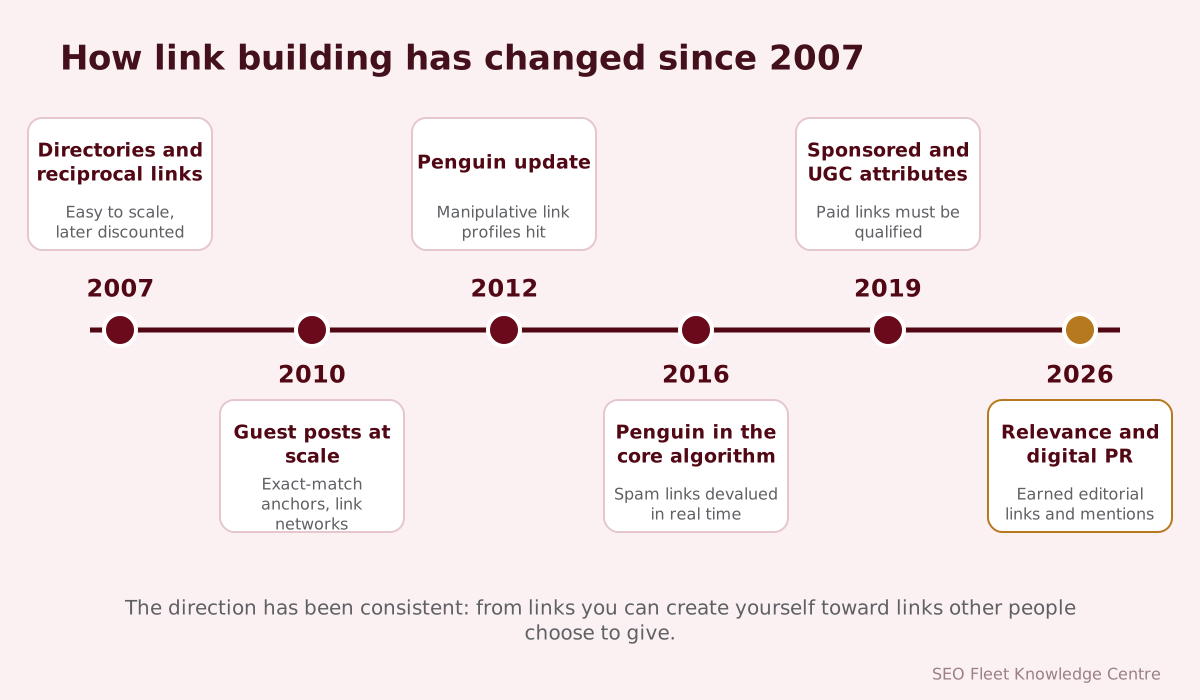
SEO Fleet started in 2007, when common practice looked very different:
| Era | Common tactics | What happened |
|---|---|---|
| Mid to late 2000s | Directory submissions, reciprocal link pages, forum signatures, article directories | Easy to scale, so search engines learned to discount them |
| Around 2010 to 2012 | Guest posts and articles at scale with exact-match anchors, link networks | Google’s Penguin update (2012) targeted manipulative link profiles; many sites lost rankings |
| Mid 2010s | Disavow files, link audits, cleanup | Penguin became part of the core algorithm in 2016, devaluing spam links in real time |
| Late 2010s to now | Digital PR, data-led content, expert commentary, partnerships | Focus moved to links earned through relevance and genuine value |
| 2026 | Earned editorial coverage, brand mentions, local and industry relationships | Spam detection is mature; quality and relevance dominate |
In practice, we watched each “scalable” tactic follow the same arc: it worked for a while, became widespread, was discounted, and in some cases became a liability. The lesson for 2026 is that anything you can buy or produce in bulk without anyone choosing to link is unlikely to last.
Do backlinks still matter in 2026?
Yes, in our experience and according to Google’s documentation that links are a relevance signal. But three things have changed how much they matter for a given business:
- Relevance outweighs volume. One link from a respected publication or organization in your industry or area typically does more than dozens of unrelated links.
- Content and experience matter more. Google’s systems put heavy weight on helpful, reliable, people-first content and page experience. Links cannot rescue a thin or unhelpful page.
- Spam links are mostly ignored. Because Google aims to nullify spam links, buying low-quality links usually wastes money even when it does not trigger a penalty.
For many local service businesses, the most important “links” are not traditional SEO links at all: accurate listings, a complete Google Business Profile, genuine reviews and mentions by local organizations. For competitive national or ecommerce terms, earned links from relevant sites are often a significant differentiator.
Which links carry value and which carry risk?
| Usually valuable | Usually worthless or risky |
|---|---|
| Editorial links from relevant publications that chose to cite you | Paid links without rel="sponsored" |
| Links from industry associations, partners and suppliers you genuinely work with | Private blog networks (PBNs) and link farms |
| Local news, chambers of commerce, community and event sites | Bulk directory submissions and “1,000 backlinks” packages |
| Citations of your original research, data or tools | Guest posts placed at scale with keyword-rich anchors |
| Expert quotes in journalism | Automated comment, forum or profile links |
| Resource pages that genuinely reference useful content | Excessive link exchanges (“link to me and I’ll link to you”) |
Signs that a link is valuable: the linking site has real readers, covers topics related to yours, the link appears in context because it helps the reader, and you would be happy to receive the link even if search engines did not exist.
Nofollow, sponsored and UGC links: still useful?
Since 2019 Google has treated nofollow, sponsored and ugc as “hints” rather than strict instructions. That does not mean you should seek them for ranking value. Their real worth is in referral traffic, brand visibility and credibility. A sponsored placement in a newsletter your customers read, properly labeled, can be a good marketing decision on its own merits.
Links and AI search
As AI Overviews, AI Mode and AI assistants change how people find information, some vendors claim that links no longer matter, while others sell “AI citation” packages. Google’s guidance on its generative AI features says that optimizing for them is still SEO, built on the same foundations as ranking in Search. Being a recognized, trusted source, often reflected in mentions and links from reputable sites, remains part of that. There is no documented shortcut for being cited by AI systems.
Red flags when buying link building services
- Guaranteed rankings, a guaranteed number of links on “high DA” sites, or “Google-safe” claims.
- Fixed price lists for links on specific sites (a sign of paid links).
- No list of where links will be placed or refusal to show examples.
- Promises of hundreds of links per month.
- Exact-match anchor text as a selling point.
- Sites with no real audience, written for links rather than readers.
Google’s own guidance on hiring an SEO warns businesses to be wary of anyone who guarantees rankings or claims a special relationship with Google.
What a sensible approach looks like in 2026
- Fix the foundations first: technical SEO, useful content and a site worth linking to.
- Audit existing links: understand what you have and whether any past activity creates risk. Most sites do not need a disavow file; Google says it is for cases where you have many spammy links you created or paid for and have or expect a manual action.
- Create link-worthy assets: original data, expert guides, tools, local resources.
- Build relationships: with journalists, industry bodies, partners and local organizations.
- Measure what matters: referral traffic, rankings for target topics and leads, not just link counts.
Our companion guide, how to build quality backlinks, sets out twelve practical strategies and a 90-day plan.
Links vs. brand mentions
A brand mention is a reference to your business without a link. Google has not documented using unlinked mentions as a ranking signal, so treat claims that they directly boost rankings as opinion. Mentions still matter for marketing: they build awareness, send people to search for you by name and lend credibility. They are also often an easy opportunity to ask for a link, because the author has already chosen to reference you.
Internal links: the link building you fully control
Links between pages on your own website help search engines discover pages and understand how they relate, and help visitors find what they need. Google’s documentation encourages crawlable links with descriptive anchor text. Practical steps include linking from popular pages to important service pages, connecting related articles, avoiding orphan pages that nothing links to and using descriptive anchor text rather than “click here.” Internal linking is often the quickest link-related improvement available.
Common myths about backlinks
| Myth | Reality |
|---|---|
| More links always means higher rankings | Relevance and quality matter far more than count; many links are ignored |
| Domain Authority is a Google metric | It is a third-party estimate; Google does not use it |
| Competitors can easily destroy your rankings with spam links | Google says it works to ignore spam links; negative SEO is uncommon |
| Nofollow links are worthless | They can bring visitors and credibility, and Google treats them as hints |
| Links from .edu or .gov sites are always powerful | The domain ending does not make a link valuable; relevance and editorial choice do |
| Links no longer matter because of AI | Google’s guidance says optimizing for AI features is still SEO |
How to evaluate a link building proposal
- Ask exactly how links will be earned and for examples of past placements.
- Ask whether any money changes hands with publishers, and how those links are qualified.
- Check whether example sites have real readers and relevant content.
- Ask how success will be measured beyond link counts.
- Make sure you can stop the work without losing ownership of content created for you.
Conclusion: link building works when it stops looking like link building
Backlinks are still part of how search engines understand the web, but the value comes from relevance and genuine endorsement. The tactics that could be scaled and bought have steadily lost their value since the late 2000s. What works now is closer to good public relations and partnership-building: create something worth referencing, put it in front of the right people, and let them decide to link. Nobody can honestly guarantee the outcome, and that is exactly why the links that result are valuable.


