


If links still matter, and the old shortcuts no longer work, what does work? This guide answers that question practically. It covers how to judge whether a link is worth having, twelve strategies we use and recommend, what to avoid, how to measure results, and a 90-day plan to get started.
A word of honesty first: no strategy below guarantees links. Every one of them depends on someone else deciding your content, data or expertise is worth referencing. That is exactly why they work. If you want background on why the approach has changed, read does link building still work in 2026?
What makes a backlink “quality”?
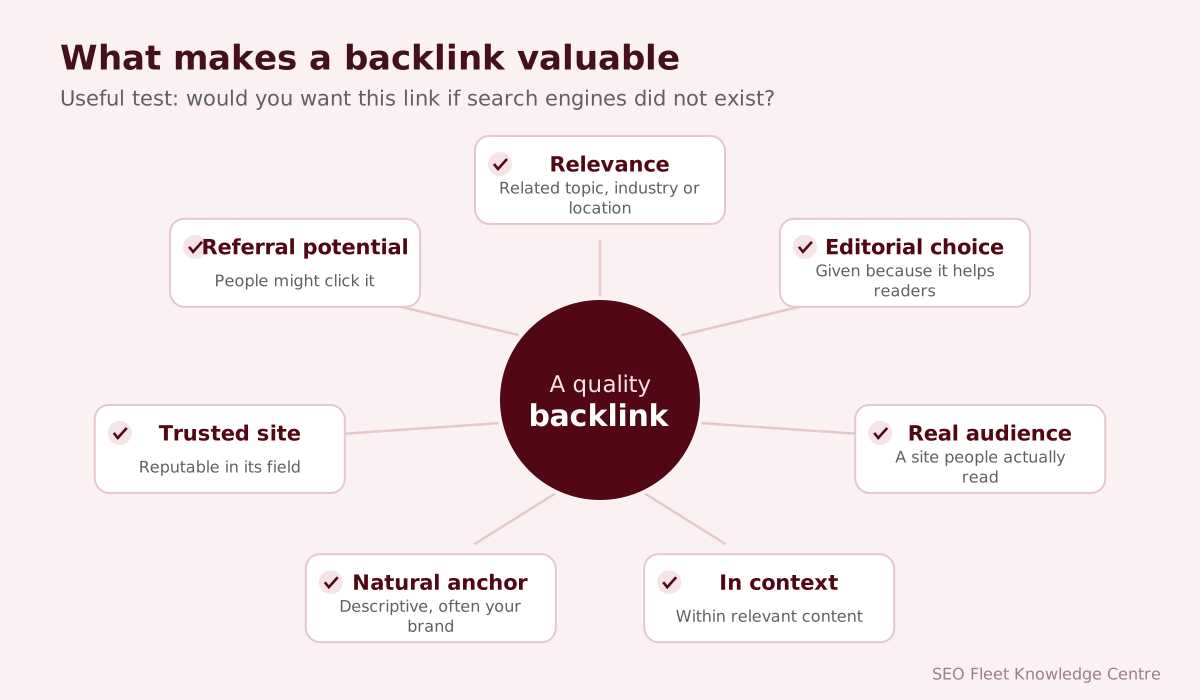
- Relevance: the linking site and page relate to your topic, industry or location.
- Editorial choice: someone chose to link because it helps their readers, not because they were paid.
- Real audience: the site has genuine readers and is not built only to host links.
- Context: the link sits within relevant content, not in a footer list or a page of unrelated links.
- Natural anchor text: descriptive and varied, often your brand name or a natural phrase, not repeated exact-match keywords.
- Trust: the site is reputable in its field.
- Referral potential: people might actually click it.
Third-party metrics such as Domain Authority or Domain Rating can help you sort a list quickly, but they are vendor estimates. A relevant local site with a modest score can be worth more to you than a high-scoring site in an unrelated niche.
12 proven strategies to build quality backlinks
1. Create original research and data
Journalists and bloggers need facts to cite. A survey of your customers, an analysis of your own anonymized data or a study of public data in your industry can earn links for years. Publish the method, the sample size and clear charts. Example: a home services company analyzes several years of its own job records to show which months see the most emergency repairs, and local news uses it in seasonal stories.
2. Publish genuinely useful guides and tools
The most-linked resources in many industries are definitive guides, checklists, calculators and templates. Aim to create the best answer to a question your audience keeps asking, then keep it updated.
3. Digital PR and newsworthy stories
Digital PR means creating stories journalists want to cover: data, expert insights, timely commentary or notable company news, then pitching them to relevant reporters. Good digital PR earns links, brand mentions and credibility at the same time.
4. Respond to journalist requests as an expert
Journalists regularly look for expert sources through request services and social media. Responding quickly with a specific, quotable, accurate answer can earn a mention and often a link. Only answer where you have real expertise.
5. Reclaim unlinked brand mentions
Search for mentions of your business, products or people that do not link to you. A polite note thanking the author and suggesting a link to the relevant page often succeeds, because the author already chose to mention you.
6. Fix and reclaim lost links
Check for links pointing to pages on your site that now return errors, often after a redesign. Redirect old URLs to the most relevant current pages with 301 redirects so those links keep working. This is one of the quickest wins available.
7. Broken link building
Find relevant pages that link to resources that no longer exist. If you have (or create) a genuinely good replacement, let the site owner know about the broken link and suggest your resource. Lead with helping them fix their page.
8. Build real partnerships
Suppliers, manufacturers, distributors, clients, technology partners and professional associations often list partners, members or certified providers. These links are relevant by definition. Ask for listings where a real relationship exists.
9. Get involved locally
Sponsoring local events, teams or charities, speaking at community events, joining your chamber of commerce and collaborating with local businesses all create local mentions and links. Sponsorship links should be qualified as sponsored where appropriate; their value is local visibility and reputation. See what is local SEO.
10. Contribute expert content to relevant publications
Writing an occasional, genuinely useful article for a respected publication in your industry, to reach its readers, is legitimate. Google’s spam policies target large-scale guest posting campaigns with keyword-rich anchor links. Write for the audience, accept the publication’s editorial standards and linking policy, and do not do it at volume purely for links.
11. Earn links from resource and “best of” pages
Universities, associations, government bodies and bloggers often maintain lists of useful resources. If your guide or tool genuinely deserves a place, a short, personal suggestion is appropriate. Never offer payment for inclusion without the link being qualified.
12. Promote your best content consistently
Good content rarely earns links if nobody sees it. Share it with your email list, on social media, in communities where it is relevant and with people you referenced. More visibility among the right people means more chances for natural links.
Link building strategies compared
| Strategy | Effort | Time to results | Best for |
|---|---|---|---|
| Original research | High | Medium to long | Brands that want national coverage |
| Useful guides and tools | Medium to high | Long, compounding | Most businesses |
| Digital PR | High | Medium | Companies with stories or data |
| Expert commentary | Low to medium | Short | Founders and specialists |
| Unlinked mentions | Low | Short | Established brands |
| Lost link reclamation | Low | Short | Sites that have been redesigned |
| Broken link building | Medium | Medium | Sites with strong resources |
| Partnerships | Low | Short | B2B and suppliers |
| Local involvement | Medium | Medium | Local businesses |
| Expert articles | Medium | Medium | Thought leaders |
| Resource pages | Low to medium | Medium | Educational content |
| Content promotion | Ongoing | Ongoing | Everyone |
What to avoid
- Buying links that pass ranking value (without
rel="sponsored"ornofollow). - Private blog networks (PBNs) and sites built only to sell links.
- Bulk directory and bookmarking submissions beyond a small number of genuinely relevant, quality directories.
- Large-scale guest posting with keyword-rich anchors.
- Excessive link exchanges and “link wheels.”
- Automated tools that create links on forums, comments or profiles.
- Hidden links in widgets, themes or footers distributed across many sites.
- Anyone guaranteeing a number of links, specific metrics or rankings.
Outreach that people respond to
- Personalize every message: show that you know their site and why your resource fits.
- Lead with value to them and their readers, not with your request for a link.
- Keep it short, specific and easy to act on.
- Follow up once, politely, then move on.
- Comply with email laws such as CAN-SPAM and, where relevant, GDPR, and respect “no.”
How to measure link building results
- Links earned: relevant, editorial links and mentions, reviewed for quality rather than counted.
- Referral traffic: visits from linking sites in GA4.
- Rankings and visibility: changes for the target topics in Search Console.
- Brand mentions and searches: growth in branded search queries.
- Leads and revenue: the ultimate measure, attributed as reasonably as possible.
Results take time. Links from good campaigns often appear over weeks or months, and their effect on rankings is gradual and influenced by many other factors.
A practical 90-day link building plan
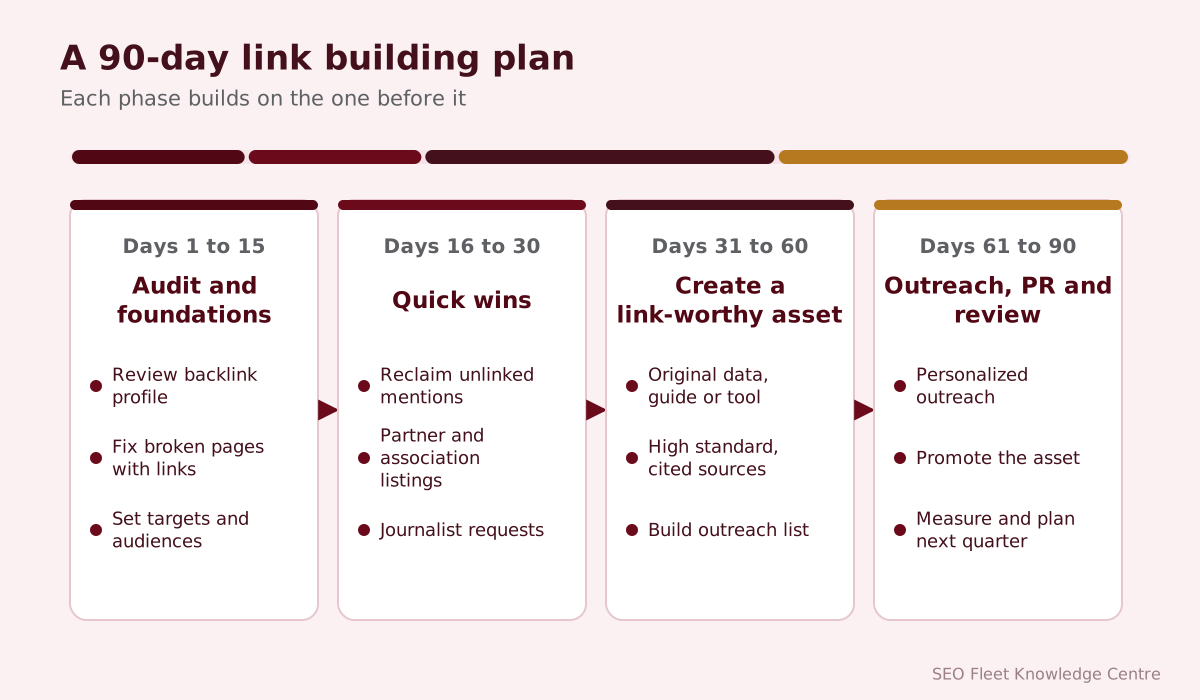
Days 1 to 15: audit and foundations
- Review your current backlink profile and note any risky past activity.
- Check for broken pages with inbound links and set up 301 redirects.
- Identify your most link-worthy existing content and gaps.
- Define target topics, audiences and the kinds of sites that would naturally reference you.
Days 16 to 30: quick wins
- Reclaim unlinked brand mentions.
- Ask genuine partners, suppliers and associations for listings.
- Update and complete local listings and Google Business Profile.
- Start responding to relevant journalist requests.
Days 31 to 60: create a link-worthy asset
- Choose one asset: original data, a definitive guide, a tool or a local resource.
- Build it to a high standard with clear sources and visuals.
- Prepare a list of relevant journalists, bloggers and resource pages.
Days 61 to 90: outreach, PR and review
- Run personalized outreach and pitch the story behind the asset.
- Promote it through email, social and communities.
- Track links, mentions, referral traffic and rankings.
- Review what worked and plan the next quarter.
Link-worthy asset ideas by business type
| Business type | Asset ideas |
|---|---|
| Local service business | Seasonal maintenance checklist for your area, local cost guide, community resource list |
| Professional services | Plain-English guides to new regulations, annual industry survey, templates |
| Ecommerce | Buying guides, sizing or compatibility tools, care instructions, trend data from anonymized sales |
| SaaS and technology | Free tools, benchmark reports, open documentation, integration guides |
| Healthcare and wellness | Medically reviewed patient guides, clinic resources, community health events |
| Manufacturing and B2B | Technical specifications, standards explainers, application guides for partners |
A sample outreach email
Here is a short, adaptable example for a broken link opportunity. Personalize every part of it:
Subject: A broken link on your home energy resources page
Hi Sarah,
I was reading your list of home energy resources and noticed the link to the insulation guide in the third section now returns an error.
We recently published a guide to choosing insulation for older homes, with the costs and tradeoffs of each type explained. It might work as a replacement: [link]. Either way, I hope the heads-up is useful.
Best regards,
[Name], [Company]
Notice what it does: it shows the sender actually read the page, it helps the recipient fix a real problem, and the request is optional.
Tools that help with link building
- Google Search Console: the Links report shows sites linking to you and your most linked pages, free and directly from Google.
- Backlink tools such as Ahrefs, Semrush, Moz and Majestic: discovering competitors’ links, broken pages and mentions. Their metrics are estimates.
- Brand monitoring such as Google Alerts: finding new mentions to reclaim.
- A simple spreadsheet or CRM: tracking who you contacted, when and the result, so outreach stays organized and respectful.
Link building for local businesses
Local businesses have a natural advantage: real relationships in a real community. Some of the most effective sources are local news, community organizations, sports clubs, schools, business associations, event listings, suppliers and neighboring businesses. Combine these with an accurate Google Business Profile, consistent citations and genuine reviews, and many local businesses need far less traditional “link building” than they are sold.
Conclusion: earn links by being worth linking to
Quality backlinks come from a simple sequence: create something useful, show it to the people who would genuinely benefit, and build relationships that make you a natural source. It takes more effort than buying a package, but the links you earn keep their value, carry no policy risk and usually bring visitors and credibility along with them.
SEO Fleet offers link building, content marketing and local SEO services built on these principles.


